
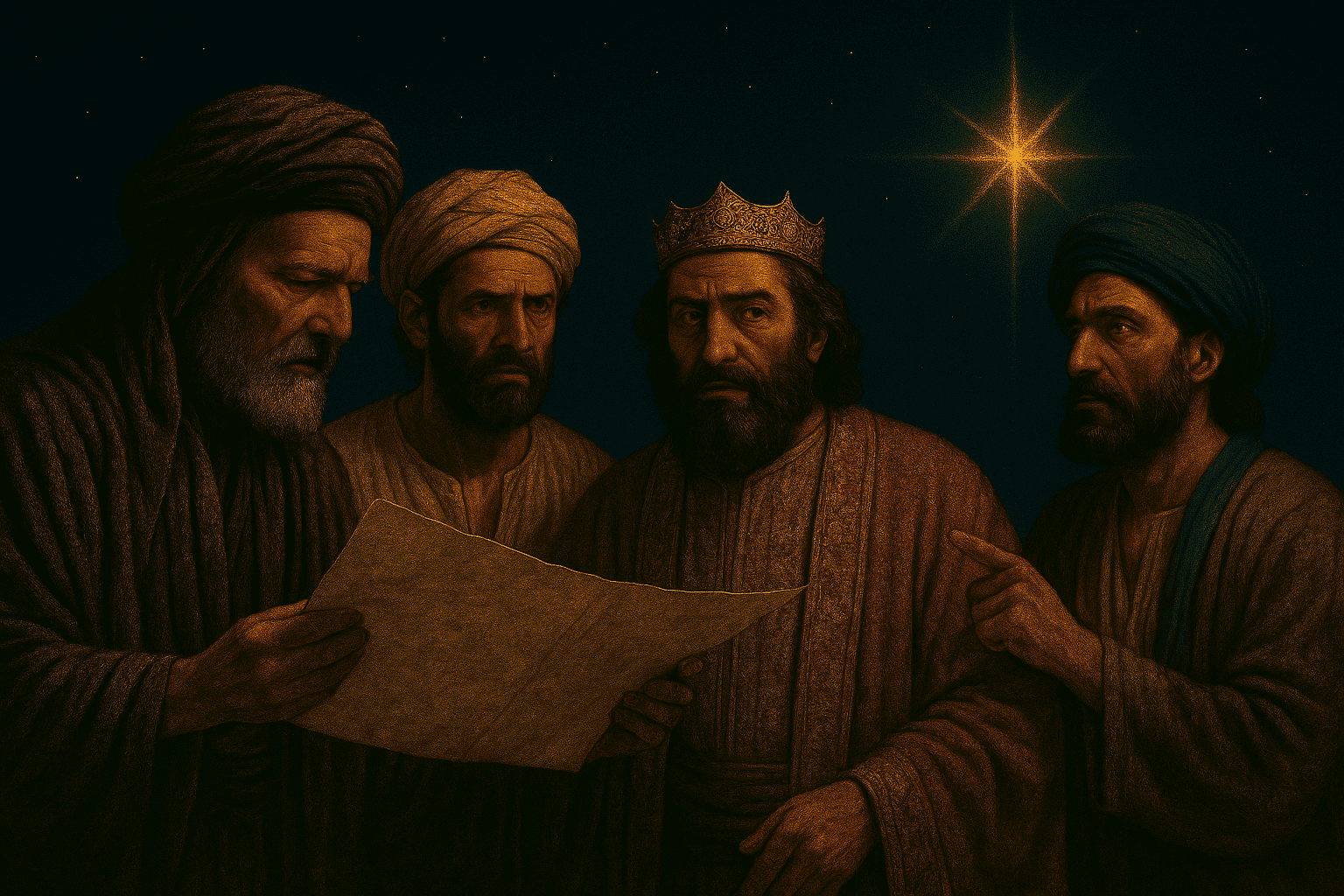
Nativity Naiveté
“Uhhhh… who is this guy?”
A nativity tableau Scripture never describes.
Maybe it’s time we read the text (like a Berean) before we start singing the songs.
Conflating the events of Jesus Birth with Future Prophecy
“Now after Jesus was born in Bethlehem of Judea in the days of Herod the king, behold, wise men from the East came to Jerusalem, saying, ‘Where is he who has been born King of the Jews? For we saw his star when it rose and have come to worship him.’”
—Matthew 2:1–2, ESV
Matthew’s account provides sparse details: magi arrive from the East, seek Israel’s newborn king, follow a star, present three gifts—gold, frankincense, and myrrh—and depart by another route after divine warning. The text identifies them simply as magoi (μάγοι), a Greek transliteration of the Persian term for learned advisors, dream interpreters, and students of celestial phenomena. Matthew records neither their number nor their names nor their royal status. Yet every Christmas, many churches sing of three kings bearing gifts, even giving them names—Caspar, Melchior, and Balthazar—and places crowned figures beside shepherds at the manger, creating a nativity tableau Scripture never describes. The question confronting us is not whether these traditions carry emotional resonance or cultural value, but whether they accurately represent what God inspired Matthew to record—and whether our preference for a more majestic story reveals something troubling about how we handle Scripture when it fails to meet our narrative expectations.
When Tradition and Poetic License Distract from Truth—Sentiment over Scripture
How did “magi from the East” become “three kings”? How did gifts numbering three become men numbering three? How did “a house” (Matthew 2:11) become a stable, and “after Jesus was born” become “that very night”? These are not minor details or harmless embellishments—they represent systematic additions to the biblical text, each layer of tradition moving further from what Matthew actually wrote. The church has defended these additions for centuries, often by appealing to ancient tradition, poetic license, or Old Testament prophecies about kings bringing tribute to the Messiah. But at what point does tradition’s accumulated weight begin to obscure Scripture’s actual testimony? And more pressingly: if the prophecies about kings do not find their fulfillment in Matthew 2, where do they find it? Does Scripture’s refusal to give us royal visitors at the nativity mean the prophecies failed—or that we have been looking for their fulfillment in the wrong place, at the wrong time, demanding clarity where God has structured His revelation differently? This article examines what Matthew actually records, interrogates our traditional additions, and asks whether our nativity assumptions reveal a troubling preference for sentiment over Scripture.
What Matthew Actually Says—and Doesn’t Say
The text provides specific details that tradition systematically contradicts. Matthew identifies the visitors as magoi—neither kings (basileis, βασιλεῖς) nor royal emissaries. The Greek term denotes a learned class from Mesopotamia or Persia: court advisors, dream interpreters, and students of celestial phenomena. This was Daniel’s institutional context when Nebuchadnezzar appointed him “ruler over the whole province of Babylon and chief prefect over all the wise men of Babylon” (Daniel 2:48). Later, the queen mother identifies Daniel using the same terminology: “King Nebuchadnezzar, your father—your father the king—made him chief of the magicians, enchanters, Chaldeans, and astrologers” (Daniel 5:11). The magi of Matthew 2 emerge from this institutional lineage—scholars and advisors, not monarchs.
Matthew records three gifts but never specifies the number of visitors. The church’s assumption that three gifts necessitate three men finds no textual warrant. A caravan traveling hundreds of miles through potentially hostile territory would likely include multiple travelers, servants, guards, and animals—yet Matthew’s narrative focus remains on the gifts themselves and their theological significance rather than the logistics of the journey. Could there have been two magi? Seven? A dozen? The text does not say, because the number holds no theological importance. What matters is what they brought and why they brought it—the royal gold acknowledging Christ’s kingship (Psalm 72:15), the priestly frankincense suitable for worship (Exodus 30:34–38), and the burial myrrh foreshadowing His atoning death (John 19:39). These gifts testify to Jesus’s identity; the number of gift-bearers does not.
The traditional nativity scene compounds the error by placing the magi at the stable alongside shepherds, suggesting they arrived on the night of Jesus’s birth. Matthew’s chronology contradicts this scenario at multiple points. Luke records that shepherds visited “a baby wrapped in swaddling cloths and lying in a manger” (Luke 2:12, 16), while Matthew describes magi entering “the house” and finding “the child with Mary his mother” (Matthew 2:11)—not a newborn infant in a feeding trough but a paidion (παιδίον), a young child, in a residence. The Greek distinguishes between brephos (βρέφος, newborn infant) used in Luke 2:12, 16 and paidion used throughout Matthew 2. This linguistic precision suggests the passage of time between birth and the magi’s arrival.
Further chronological evidence emerges from Herod’s response. After the magi depart without reporting Jesus’s location, Herod orders the execution of “all the male children in Bethlehem and in all that region who were two years old or under, according to the time that he had ascertained from the wise men” (Matthew 2:16). Why two years if Jesus was a newborn? Herod’s calculation suggests the star’s appearance coincided with Jesus’s birth, and the magi’s subsequent journey—requiring months of preparation, travel, and navigation—meant they arrived when Jesus was a toddler, not an infant. The house, the child’s age, and Herod’s timeline all indicate significant time elapsed between Luke’s nativity account and Matthew’s magi narrative. Yet our Christmas pageants collapse these events into a single night, creating a scene Scripture never describes.
Why does the church persist in defending these additions? Is it merely tradition’s inertia, or does something deeper drive our resistance to Matthew’s sparse account? Could it be that we find the biblical narrative insufficient—lacking the grandeur, the symmetry, the poetic closure we desire? The question presses: at what point does our preference for a more satisfying story constitute an implicit judgment that Scripture’s version needs improvement?
The Prophecies About Kings—Misapplied or Misunderstood?
Defenders of the “three kings” tradition often appeal to Old Testament prophecies about royal tribute to the Messiah. Psalm 72 envisions the messianic king: “May the kings of Tarshish and of the coastlands render him tribute; may the kings of Sheba and Seba bring gifts! May all kings fall down before him, all nations serve him!” (Psalm 72:10–11). Isaiah prophesies about restored Jerusalem: “Nations shall come to your light, and kings to the brightness of your rising… They shall bring gold and frankincense, and shall bring good news of the praise of the LORD” (Isaiah 60:3, 6). These passages clearly depict kings bringing tribute—so if the magi are not kings, have these prophecies failed?
This question exposes a fundamental error in how we read prophetic literature. The prophecies cited above were never about Bethlehem. They were never about Jesus’s infancy. They were never about a single nocturnal visit by Eastern scholars. Psalm 72 describes the Messiah’s reign—”May he have dominion from sea to sea, and from the River to the ends of the earth!” (Psalm 72:8)—not His birth. The psalm envisions universal submission to the messianic king’s authority, not a courtesy call during His childhood. Isaiah 60 similarly looks forward to Jerusalem’s eschatological glory when “the wealth of the nations shall come to you” (Isaiah 60:5) and “your gates shall be open continually; day and night they shall not be shut, that people may bring to you the wealth of the nations, with their kings led in procession” (Isaiah 60:11). This is not the modest house in Bethlehem that the magi visited—this is the New Jerusalem toward which all nations stream.
Revelation makes this explicit. John sees the New Jerusalem descending from heaven, and records: “The nations will walk by its light, and the kings of the earth will bring their glory into it. Its gates will never be shut by day—and there will be no night there. They will bring into it the glory and the honor of the nations” (Revelation 21:24–26). Here the prophecies find their ultimate fulfillment—not in Matthew 2 but in Revelation 21, not at Christ’s birth but at the consummation of His kingdom, not with three visitors bearing gifts but with the kings of the earth bringing the glory and honor of all nations into God’s eternal city.
The error lies not in the prophecies but in our truncated reading of them. We have taken texts describing the Messiah’s universal reign and forced them into the narrative of His birth. We have conflated beginning with culmination, nativity with eschaton, first advent with second advent. The prophecies promised that kings would bow before the Messiah—and they will. But that promise finds its fulfillment in the kingdom age and the eternal state, not in a Judean house during Herod’s reign. Why have we insisted on collapsing prophetic scope into a single night? Could it be that we prefer tidy fulfillment to the patient unfolding of God’s redemptive purposes across centuries?
The Forgotten Lineage: Daniel’s Legacy and the Magi’s Knowledge
If the magi were not kings, then who were they—and why did they know what Israel’s own leaders missed? Matthew offers no explanation, assuming his readers will make the connection. But six centuries before Christ’s birth, Scripture records a remarkable precedent: Daniel and his three companions were placed over Babylon’s wise men, the institutional predecessors of Matthew’s magi. When Nebuchadnezzar promoted Daniel to “ruler over the whole province of Babylon and chief prefect over all the wise men of Babylon” (Daniel 2:48), he positioned a Hebrew prophet at the head of the very class from which the magi would later emerge. This was not honorary leadership but administrative authority—Daniel supervised Babylon’s intellectual infrastructure, including its educational institutions and advisory councils.
Could Daniel’s six decades of influence have reshaped what these wise men studied? Consider what theological knowledge Daniel would have transmitted: The prophecy of the seventy weeks provides explicit messianic chronology—”from the going out of the word to restore and build Jerusalem to the coming of an anointed one, a prince, there shall be seven weeks. Then for sixty-two weeks it shall be built again” (Daniel 9:25). This prophecy identifies both the timing and the title of the coming Messiah, offering exactly the framework needed to anticipate His appearance. Daniel’s apocalyptic visions reinforce messianic expectation: the stone cut without hands that becomes a mountain filling the earth (Daniel 2:34–35, 44), the Son of Man receiving universal dominion (Daniel 7:13–14). These prophecies, combined with Numbers 24:17—”A star shall come out of Jacob, and a scepter shall rise out of Israel”—provide the theological foundation for interpreting astronomical phenomena as heralding Israel’s king. Matthew never calls it a natural star but treats it as a divinely guided sign—consistent with Daniel’s pattern of God revealing mysteries to Gentile rulers through supernatural means (Daniel 2:19, 28, 47).
But Daniel transmitted more than prophetic content—he established a methodology for recognizing divine communication. Throughout Daniel’s narrative, God speaks through dreams: Nebuchadnezzar’s troubling visions (Daniel 2, 4), Daniel’s own prophetic dreams (Daniel 7–12), Belshazzar’s supernatural writing requiring Daniel’s interpretation (Daniel 5). The pattern is consistent: God reveals, faithful servants interpret, and obedience to revelation becomes the measure of wisdom. Perhaps this explains the magi’s immediate response to their warning dream—”being warned in a dream not to return to Herod, they departed to their own country by another way” (Matthew 2:12). They did not seek confirmation, did not consult one another, did not question the message. Could their readiness to trust a dream reflect a Daniel-shaped theology of divine communication, transmitted across centuries through institutional memory?
The question grows sharper when we consider the Jewish diaspora. Many Jews remained in Mesopotamia after Cyrus’s decree, establishing communities that persisted for centuries (Ezra 7–8, Nehemiah 1:1, Esther). These diaspora Jews maintained their scriptures and messianic hopes while integrating into Persian society. Is it possible that some entered the ranks of the magi themselves, bringing the full weight of Hebrew Scripture into the institution Daniel once led? Or perhaps Gentile magi, through generations of contact with Jewish communities, absorbed enough scriptural knowledge to recognize messianic signs? Either scenario—ethnic Jewish magi or Gentile scholars trained in Jewish prophecy—explains what Matthew’s sparse narrative assumes: these Eastern visitors possessed theological knowledge that prepared them to interpret both celestial signs and Hebrew Scripture.
Why does the church prefer imaginary crowns to this documented lineage? The magi’s connection to Daniel offers something far more theologically compelling than royal status—they represent the firstfruits of a prophetic legacy, the harvest of seeds planted by a faithful exile six centuries earlier. They testify to God’s patience in preparing hearts across generations and His sovereignty in orchestrating history so that Gentile scholars trained in Daniel’s tradition would recognize Israel’s Messiah when Jewish leadership missed Him. Yet we crown them instead, preferring the grandeur of monarchy to the scandal of grace reaching those we consider unlikely.
For more on questions about the Magi, see this article: Wise Men from the East
The Real Scandal: Gentile Recognition Before Jewish Rejoicing
The magi’s arrival exposes a pattern of reversal that runs throughout the gospel. Matthew records that when the magi inquired about the newborn king, King Herod “was troubled, and all Jerusalem with him” (Matthew 2:3). The contrast is stark: outsiders worship while insiders are troubled, Gentile scholars recognize what Jerusalem’s religious establishment misses, those far from the covenant prove nearer to its fulfillment than those within it. This is not accidental but prophetic—Isaiah promised that “nations shall come to your light” (Isaiah 60:3), and the magi embody that promise’s initial fulfillment, the opening note of a symphony that crescendos in Revelation when “a great multitude that no one could number, from every nation, from all tribes and peoples and languages” stands before the Lamb (Revelation 7:9).
The magi’s worship carries theological weight precisely because they were not expected. They were not ethnic Israel, not covenant members, not recipients of the law or prophets in the way Judea possessed them. Yet they sought Christ, recognized His significance, and prostrated themselves in worship—prosekynēsan (προσεκύνησαν), the same verb Matthew uses throughout his gospel for worship directed to God (Matthew 4:10, 14:33, 28:9, 28:17). This was not diplomatic courtesy but divine honor, not political homage but genuine worship. Their gifts—gold befitting a king, frankincense suitable for priestly service, myrrh foreshadowing burial—testify to Jesus’s identity even if the magi did not consciously grasp the full Christological significance of what they offered.
Why does this scandal make us uncomfortable? Perhaps because it confronts our assumption that proximity to religious tradition guarantees spiritual perception. The magi traveled hundreds of miles based on fragmentary knowledge and a celestial sign, while Jerusalem’s scribes who could quote Micah 5:2 verbatim—”But you, O Bethlehem Ephrathah, who are too little to be among the clans of Judah, from you shall come forth for me one who is to be ruler in Israel” (Matthew 2:5–6)—failed to investigate whether the prophecy had found fulfillment. Knowledge alone did not produce worship; the magi’s seeking did. Could this be why we prefer to crown them—because making them kings domesticates the scandal of grace, suggesting they had some inherent worthiness that explained their recognition? But Scripture offers no such comfort. They were not kings, not specially qualified, not particularly righteous—they were seekers who acted on the revelation they possessed, however incomplete, and God brought them to Christ.
Why We Keep Crowning Them
The persistence of the “three kings” tradition despite its textual bankruptcy reveals something about how we process Scripture. We prefer narratives that feel complete, symmetrical, grand. Three gifts suggest three givers. Prophecies about kings must find immediate fulfillment. The nativity should be a tableau of cosmic significance, not a modest house visit months after the birth. So we add details, smooth rough edges, create the story we think God should have told. In doing so, we implicitly judge Scripture insufficient—not comprehensive enough, not majestic enough, not satisfying enough. The additions testify to our discomfort with what God actually revealed.
But the problem runs deeper than aesthetic preference. When tradition contradicts text, and we defend tradition, what principle remains for evaluating any theological claim? If “the Bible doesn’t explicitly say they weren’t kings” becomes sufficient justification for claiming they were, then absence of denial becomes permission for invention. This methodology, applied consistently, would authorize any addition to Scripture that the text does not explicitly forbid. The Reformers faced this precise argument when the Roman Catholic Church defended tradition as equal to Scripture, claiming the church’s authority to establish doctrine beyond the written Word. The Protestant response was sola Scriptura—Scripture alone as the final authority, tradition submitting to text rather than supplementing it. Yet here we sit, six centuries after the Reformation, still defending extrabiblical additions to the nativity because they carry emotional resonance and cultural weight?
The question presses: do we believe Scripture is sufficient for our understanding, or do we believe it requires traditional augmentation to achieve proper theological effect? If Matthew’s spare account of magi bringing gifts lacks something essential, what does that suggest about our confidence in the Spirit’s inspiration of the text? And if we permit ourselves this freedom to enhance the nativity narrative, on what basis do we resist other traditions that claim to improve upon Scripture’s testimony?
The Kings in the Kingdom, Not at the Nativity
The prophecies about kings bowing before the Messiah have not failed—they await fulfillment in precisely the context Scripture promised. Psalm 72 envisions the Messiah’s reign: “May all kings fall down before him, all nations serve him!” (Psalm 72:11). This is future, not past. The psalm describes dominion extending “from sea to sea” (Psalm 72:8) and deliverance for “the needy when he calls, the poor and him who has no helper” (Psalm 72:12)—descriptions of the messianic kingdom’s justice, not the nativity’s circumstances. Isaiah 60 similarly looks forward to Jerusalem’s eschatological restoration: “the wealth of the nations shall come to you… They shall bring gold and frankincense” (Isaiah 60:5–6). These are not isolated visitors bearing diplomatic gifts but the comprehensive streaming of nations toward Zion’s light.
Revelation confirms this eschatological framework. When John describes the New Jerusalem, he records that “the nations will walk by its light, and the kings of the earth will bring their glory into it” (Revelation 21:24). This is the ultimate fulfillment—not three travelers in Bethlehem but the kings of the earth processing into God’s eternal city, not gold and frankincense and myrrh but “the glory and the honor of the nations” (Revelation 21:26). The prophecies pointed beyond the first advent to the consummated kingdom, beyond Christ’s birth to His eternal reign, beyond the humble beginning to the glorious conclusion.
What becomes of the kings, then? They show up—just not where we keep trying to place them. They appear not in Matthew 2 but in Revelation 21, not at the manger but at the throne, not as curious visitors but as submissive subjects bringing tribute to the King of kings. The prophecies were never about the nativity; they were always about the kingdom. And the magi? They were not the fulfillment of these royal prophecies but the firstfruits of something equally significant—the ingathering of Gentile worshipers from every nation, tribe, and tongue, the initial evidence that Christ’s kingdom would transcend ethnic boundaries and draw seekers from the uttermost parts of the earth.
Perhaps this is why we resist the correction. If the magi were not kings, if the prophecies point beyond the nativity to the eschaton, then we must live with unresolved expectation. We must embrace the tension between promise and fulfillment, between Christ’s first advent establishing the kingdom and His second advent consummating it. We must resist the flattening impulse that demands immediate resolution of every prophetic word. This requires patience with God’s timeline, trust in His sovereign orchestration of history, and humility before mysteries we cannot yet fully comprehend. It is easier to crown the magi and declare the prophecies fulfilled than to wait with the tension of promises that await their ultimate realization.
Our discomfort with Scripture’s actual testimony
“Now after Jesus was born in Bethlehem of Judea in the days of Herod the king, behold, wise men from the East came to Jerusalem, saying, ‘Where is he who has been born King of the Jews? For we saw his star when it rose and have come to worship him.’” Matthew’s account offers neither the grandeur we crave nor the tidy symmetry we prefer. It gives us magi, not kings. Scholars from the East, possibly heirs of Daniel’s prophetic legacy, not crowned monarchs fulfilling royal prophecies. A house visit months after the birth, not a manger scene on the night of the nativity. Three gifts testifying to Jesus’s identity, not three men satisfying our desire for numerical correspondence.
The church’s centuries-long preference for “three kings” over Matthew’s magi reveals our discomfort with Scripture’s actual testimony. Perhaps we want prophecies fulfilled immediately, narratives concluded definitively, mysteries resolved tidily. Perhaps we want kings at the nativity because it feels more appropriate, more majestic, more fitting for the King of kings. But Scripture gives us something better—Gentile seekers, possibly trained in Daniel’s tradition, acting on fragmentary knowledge and divine guidance to worship the Jewish Messiah while Jerusalem’s leadership remains troubled and ignorant. Scripture gives us the scandal of grace reaching unexpected quarters, the pattern of reversal that will characterize Christ’s entire ministry, and the firstfruits of a global harvest that will culminate when kings do finally bow—not in Bethlehem but in the eternal city, not at the nativity but at the throne, not as curious visitors but as worshipers bringing the glory of all nations to the Lamb.
The question confronting us is not whether tradition carries emotional or cultural value—of course it does. The question is whether tradition’s value permits it to override Scripture’s testimony. And the answer, if we truly believe in the sufficiency and authority of God’s Word, must be no. The magi’s story is scandal enough without crowning them. Let us learn to sit with what God actually revealed rather than enhancing it with what we wish He had said.
Editor’s Note
Historical Development of the Tradition
This article examines the tension between traditional nativity imagery and Matthew’s actual narrative. The “three kings” tradition developed over centuries through various extrabiblical sources—the third-century Excerpta Latina Barbari first numbers the magi as three, the sixth-century Excerptum de Nativitate names them Bithisarea, Melichior, and Gathaspa, and medieval Western tradition settled on Caspar, Melchior, and Balthazar. The attribution of royal status likely stems from attempts to see Psalm 72:10–11 and Isaiah 60:3, 6 fulfilled at Christ’s birth rather than awaiting eschatological realization.
The article’s interrogative and corrective tone reflects the “That’s What You Think” category’s mandate to challenge popular assumptions with scriptural rigor. Where tradition contradicts text—the magi’s royal status, their number, the timing and location of their visit—correction must be firm even if uncomfortable. However, the correction serves not to diminish the nativity’s significance but to restore Matthew’s actual testimony: Gentile seekers, possibly heirs of Daniel’s prophetic legacy, recognize and worship Israel’s Messiah while Jewish leadership remains troubled and ignorant.
The theological certainties remain: The magi were Eastern scholars (magoi), not kings (basileis). Matthew records three gifts but never specifies the visitors’ number. The visit occurred in “the house” (Matthew 2:11) some time after Jesus’s birth, not at the stable on the night of the nativity. The prophecies about kings bringing tribute (Psalm 72, Isaiah 60) await fulfillment in the messianic kingdom (Revelation 21:24–26), not at Bethlehem. And the magi’s worship demonstrates the gospel’s reach beyond ethnic Israel—the firstfruits of “a great multitude that no one could number, from every nation” (Revelation 7:9).
Methodological Clarification
Readers may wonder how this article can critique extrabiblical tradition (three kings) while proposing the Daniel-magi connection, which also goes beyond Matthew’s explicit statement. The distinction is methodologically crucial:
The “three kings” tradition contradicts and adds to what Scripture states. Matthew says magoi (scholars), tradition says basileis (kings). Matthew records three gifts, tradition declares three men. Matthew places them at “the house,” tradition puts them at a manger. Each assertion either contradicts the text or adds what the text deliberately omits, then treats these additions as if they carry scriptural authority.
The Daniel-magi connection explains what Scripture shows but doesn’t explain. Daniel’s six-decade leadership of Babylon’s wise men is explicit (Daniel 2:48, 5:11). His messianic prophecies are recorded (Daniel 9:25, 7:13–14). The Jewish diaspora’s persistence in Mesopotamia is documented (Ezra 7–8, Nehemiah 1:1, Esther). The magi’s knowledge of Jewish messianic expectation is demonstrated (Matthew 2:2) but unexplained. The connection asks: “Could A + B + C explain D?” It uses only scriptural data, acknowledges uncertainty through interrogative language, and submits to what Scripture leaves unstated.
One tradition demands its additions carry equal authority with Scripture and resists correction from the text. The other proposes a possible explanation using only biblical data and maintains humility before Scripture’s silence. This distinction matters because it preserves the principle of sola Scriptura—Scripture alone as final authority. We may ask careful questions about what Scripture implies, but we may not add what Scripture omits and then defend those additions as if they were Scripture itself.
For comprehensive examination of the Daniel-magi connection, including its scriptural foundations, historical plausibility, and appropriate limitations, see “Wise Men from the East” in the “I’m No Theologian” category. That article employs interrogative language throughout, includes an extensive Editor’s Note distinguishing “historical plausibility” from “biblical certainty,” and frames the entire thesis as sanctified speculation rather than dogmatic assertion. The present article assumes that connection as one plausible explanation while focusing its corrective force on tradition’s departure from Matthew’s text—not on speculation that respects Scripture’s boundaries, but on additions that violate them.