
What does spiritual death look like from the outside?
It doesn’t say Paul’s reputation, oratory ability or even appearance caused her to pay attention, breaking through her resistance. The Lord opened her heart—a miracle of faith, not an assent to knowledge.
Resurrected to Life, Not Assent to Belief
“One who heard us was a woman named Lydia, from the city of Thyatira, a seller of purple goods, who was a worshiper of God. The Lord opened her heart to pay attention to what was said by Paul.”
— Acts 16:14 ESV
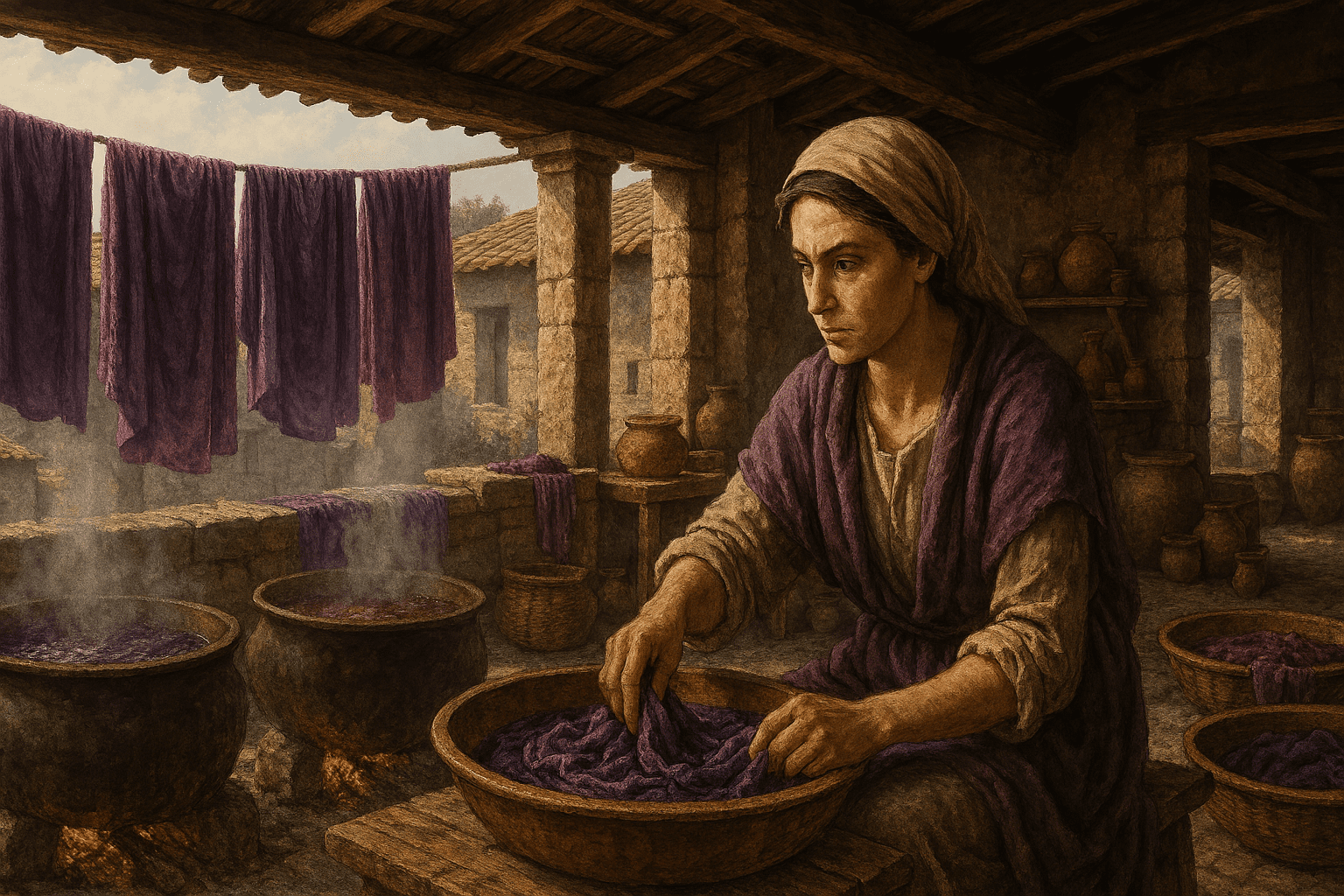
By the time Paul arrived at Philippi, he had already crossed a continent. Luke’s account in Acts 16 records one of the most consequential turns in the entire missionary narrative: a vision in the night, a Macedonian man standing and urging him to come, and an apostolic band redirected from Asia into Europe. Philippi was a Roman colony, a city of merchants, soldiers, and magistrates — and, by Luke’s own account, without a synagogue. Acts 16:13 records that Paul went outside the city gate to the river, where he supposed there was a place of prayer — the language of inference, not of a community with an established meeting house. On the Sabbath, Paul and his companions made their way to the riverside, where they found a gathering of women. Among them was Lydia — a dealer in purple cloth from Thyatira, a city in the region of Asia Minor known for its textile trade. She was a woman of evident means, evident religious seriousness, and evident attention to whatever Paul was about to say. Luke’s description of what happened next is one of the most theologically loaded sentences in the book of Acts: “the Lord opened her heart.”
That sentence rewards careful examination. It does not say that Lydia was persuaded, or that she reasoned her way to faith, or that Paul’s rhetoric finally broke through her resistance. It says the Lord opened her heart. Before that opening, she was already present. Already devout. Already listening. And still, something was closed.
The Question the Text Will Not Let Us Avoid
Luke describes Lydia as a “worshiper of God” — a designation that places her among a recognized class of Gentile adherents to Jewish monotheism, people who had turned from idolatry to the God of Israel without becoming full converts through circumcision. She was not a casual observer of religion. She was present at a riverside prayer gathering on the Sabbath, which tells us something about the habitual shape of her piety. She had, by any ordinary religious accounting, prepared herself to hear. Why, then, did the Lord still have to open her heart?
This is not a secondary question. It cuts to the root of what conversion is, what human nature is apart from God’s grace, and what it means to say that faith is a gift. If Lydia’s devotion was sufficient to bring her to the point of hearing, why was it still insufficient to open what only God could open? The answer Luke gives — quietly, structurally, in the architecture of a single sentence — is that devotion and religious orientation can bring a person to the riverbank, but only God can give the spiritual life that makes hearing become saving faith. Two things are true simultaneously in Acts 16:14: Lydia heard, and the Lord opened. Both are necessary. Only one is decisive.
The Natural Condition: Dead, Darkened, Resistant
To understand why divine opening is necessary, the reader must first understand what Luke’s broader canonical world assumes about the human heart apart from God’s action. Paul, writing to the church at Ephesus, describes the default human condition with language that should arrest any casual reading: “you were dead in the trespasses and sins in which you once walked” (Ephesians 2:1). This is not metaphor chosen for rhetorical effect. Paul means it with full ontological weight. Death in trespasses and sins is not a weakened condition that needs assistance; it is a condition that requires resurrection. The same passage returns to this vocabulary in verse 5: “even when we were dead in our trespasses, [God] made us alive together with Christ.” Made alive — not helped along, not nudged toward life, but made to live where there was no life.
The verb ‘made alive together’ — suzōopoieō (συζῳοποιέω) — carries the force of creative, life-originating action, the sun- prefix naming the union with Christ through which that life comes. It appears throughout the New Testament in contexts that link regeneration to resurrection power: the same verb used to describe Christ’s own resurrection and the Spirit’s life-giving work is here applied to the believer’s spiritual awakening. The parallel is deliberate. Paul is not describing conversion as a decision ratified by divine approval. He is describing it as a divine act of life-creation in a creature that, left to itself, had no capacity to generate that life from within.
What does spiritual death look like from the outside? Precisely like Lydia before the Lord opened her heart. Paul tells the Ephesians in chapter 4 that the unbelieving mind is “darkened in understanding, alienated from the life of God because of the ignorance that is in them, due to their hardness of heart” (Ephesians 4:18). Darkness, alienation, ignorance, hardness — these are not descriptions of people who simply haven’t heard enough. They are descriptions of a condition resistant by nature to the light it cannot receive. And in Romans 1:18, Paul sharpens this further: humanity, apart from grace, does not merely fail to reach God but actively “suppress the truth in unrighteousness.” Suppression is not passive ignorance; it is active resistance. The natural human heart does not drift toward God and simply need direction. It moves away, and it does so energetically.
This is the backdrop against which Luke’s quiet statement — “the Lord opened her heart” — carries its full weight. Lydia’s devotion was real and providentially positioned. But it did not solve the problem of spiritual deadness. Only God could do that.
The Inability of the Natural Mind
If the natural condition is death and darkness, it follows that the natural mind cannot, by its own power, receive what God offers. Paul makes this explicit in his first letter to the Corinthians: “The natural person does not accept the things of the Spirit of God, for they are foolishness to him, and he is not able to understand them because they are spiritually discerned” (1 Corinthians 2:14). The phrase “not able to understand” — drawing on the Greek root for power and capacity — is not describing a failure of willpower. It is describing a genuine incapacity. The natural person is structurally unequipped to receive spiritual truth, in the same way that a person born without hearing cannot receive a symphony through the auditory faculty that is absent.
This is why mere exposure to the gospel, even sustained and reverent exposure, does not guarantee conversion. Paul writes to the Romans that ‘to set the mind on the flesh is death’ (Romans 8:6) — not weakness, not confusion, but death. The mind oriented toward the flesh is not straining toward God and falling short; it is moving in the opposite direction entirely. What changed for Lydia was not the quality of Paul’s proclamation or the depth of her own religious attentiveness. What changed was the Lord’s action. John 3:20 frames the problem from another angle: ‘everyone who does evil hates the light and does not come to the light, lest his works should be exposed.’ The word ‘evil’ here is not limited to what society would recognize as scandalous — murder, fraud, or open immorality. Jesus speaks these words to Nicodemus, a man of irreproachable religious standing, which tells us that ‘evil’ is measured not against human moral convention but against the absolute holiness of God. By that standard, everything that falls short — including sincere religious devotion offered in place of Spirit-given life — stands in the light’s exposure. The movement away from truth is not merely a failure of curiosity; it is a moral aversion that runs deeper than education or religious sincerity can reach.
Divine Initiative: God Grants Repentance and Opens Hearts
Luke’s narrative theology in Acts is consistent on this point: the decisive act in conversion belongs to God. Acts 16:14 places the action squarely on the Lord — not on Lydia’s responsiveness, not on Paul’s persuasiveness, but on the sovereign work of God in opening what was closed. This is not an isolated theological claim; it appears as a recurring pattern throughout the same book. In Acts 11:18, when the Jerusalem church hears of Gentile conversions, their conclusion is not that the Gentiles were admirably open-minded. They glorify God and say, “Then to the Gentiles also God has granted repentance that leads to life.” Repentance — the fundamental turn of heart toward God — is here described as something granted. It is given, not generated. It originates from outside the repenting person.
The word “granted” here — drawing on the Greek verb didōmi (δίδωμι) in a construction of divine gifting — places repentance in the category of divine gift, not human achievement. This is consistent with the logic Paul employs in Ephesians 2:8: “For by grace you have been saved through faith. And this is not your own doing; it is the gift of God.” The gift language is not incidental. It is the New Testament’s way of naming the direction of the decisive movement: from God toward the dead, not from the dead toward God.
Acts 13:48 completes the picture with a grammatical precision that should not be smoothed over. At Pisidian Antioch, after Paul has proclaimed the gospel in the synagogue and some have responded while others have rejected: “and as many as were appointed to eternal life believed.” The sequence is deliberate — appointment precedes belief. Luke is not arguing that God merely foresaw who would believe and then appointed them accordingly. The grammar positions divine appointment as the antecedent of human believing. The believing is real; it is also the fruit of something prior to it, something that originates in God’s sovereign purpose.
Rejection and Hardening: The Counter-Pattern
The same chapter that records divine appointment also records its sobering counterpart. Paul says of those who rejected his message in Antioch: “you thrust aside the word of God and judge yourselves unworthy of eternal life” (Acts 13:46). The language of thrusting aside is vivid and deliberate — it describes an active, sustained rejection, not a simple misunderstanding. And the Bible’s witness is that persistent, habitual rejection hardens. Isaiah records the Lord’s commission to the prophet: “Make the heart of this people dull, and their ears heavy, and blind their eyes; lest they see with their eyes, and hear with their ears, and understand with their hearts, and turn and be healed” (Isaiah 6:10). At the close of Acts, Paul cites this very passage before the Jewish community in Rome, applying it to those who had repeatedly refused the gospel (Acts 28:25–27).
The Bible holds both truths without resolving the tension into a system: God sovereignly opens hearts, and persistent human rejection is culpable and can bring judicial hardening. These are not competing claims; they are complementary testimonies to the gravity of the gospel’s offer. The emphasis in Luke’s account of Lydia on divine opening does not erase human responsibility or make rejection impossible. It names what mercy looks like when it intervenes: God overcoming a resistance that is real, through an action that is entirely his own. The opened heart is not a heart that was simply easier to open. It is a heart that, by nature, was as closed as any other — and opened by grace.
Faith as Resurrection Life
If spiritual death is the human condition apart from grace, then faith is not the spark that creates life from a dormant self — it is the first breath drawn by someone God has raised. This is the logic embedded in Ephesians 2:5: “even when we were dead in our trespasses, [God] made us alive together with Christ.” The resurrection of Christ is not merely the model for spiritual regeneration; it is the ground and power of it. Believers are made alive together with Christ, united to his resurrection life through the Spirit’s work. Faith is the first evidence of that life, not its cause.
This reframes the entire question of why Lydia needed the Lord to open her heart even though she was already devout. Devotion — sincere, costly, habitual devotion — is not spiritual life. It can coexist with spiritual death, as Isaiah’s rebuke makes clear: “This people draw near with their mouth and honor me with their lips, while their hearts are far from me” (Isaiah 29:13). Jesus applies this same warning in Matthew 15:8 and connects it to his sobering word in Matthew 7:22–23: “On that day many will say to me, ‘Lord, Lord, did we not prophesy in your name, and cast out demons in your name, and do many mighty works in your name?’ And then will I declare to them, ‘I never knew you.’” These are not people who made no religious effort. They made extraordinary religious effort. What they lacked was the opened heart — the divine act of regeneration — that turns religious orientation into saving faith.
When Luke says the Lord opened Lydia’s heart, he is narrating in miniature what Scripture calls new birth, what Jesus describes as being born of the Spirit, and what Paul describes as new creation. It is not a modification of the old life; it is the creation of a new one. And the agent of that creation is not the human will, however sincere or religiously shaped, but God himself — the one who opens what is closed, softens what is stone, and calls forth life from death.
For Those Who Hear and Pray
The practical implications of Lydia’s conversion do not reduce to a formula, but they do carry pastoral weight in at least three directions. For those who are devout — who attend, who read, who pray, who are drawn to Scripture and to the people who love it — the account does not diminish that devotion. Lydia’s God-fearing life was not irrelevant; it placed her at the riverside where the apostle was speaking. But it does press the honest question: has the Lord opened your heart, or do you still hear from the outside? Devotion can be the occasion for conversion without being its cause. Ask God to do what only he can do.
For those who preach and witness, Luke’s account is both humbling and freeing. The burden of opening hearts does not rest on the preacher’s eloquence. It never did. Paul’s responsibility at the river was to speak the word faithfully — and he did. The Lord’s responsibility was to open hearts — and he did. These are not competing actions; they are the means and the grace working together. Preach clearly. Pray dependently. Expect that God will work through the proclamation without pretending the proclamation is sufficient on its own.
For those who shepherd congregations and disciple new believers, the distinction between visible devotion and new birth demands both patience and honesty. Not every attentive hearer is a regenerate soul. Not every serious inquirer has yet been opened. This is not cynicism; it is the biblical realism that takes spiritual death seriously and therefore takes divine opening seriously as well. Pray for the Lord to do what only he can do — and then watch for the evidence of his having done it.
Not a Mere Biographical Footnote
Lydia’s story begins with a devout woman at a riverside prayer meeting and ends with a sovereign act: the Lord opened her heart. That single phrase, quietly placed at the hinge of Luke’s sentence, is the theological key to every conversion in Scripture. We were all, by nature, dead in trespasses, darkened in understanding, suppressing the truth we could not bear to face. We could not, by our own power or piety, turn toward the God our hearts were moving away from. Yet the Lord — rich in mercy, as Paul says — softens what is stone, breathes life into what is dead, and turns devout listeners into those who truly hear and truly know and truly love him. Acts 16:14 is not merely a biographical footnote about a purple-goods merchant from Thyatira. It is the pattern of salvation itself: God acts first, and faith follows as the living evidence of resurrection. Lydia’s opened heart is the church’s testimony in miniature — and it is cause for nothing less than worship.