
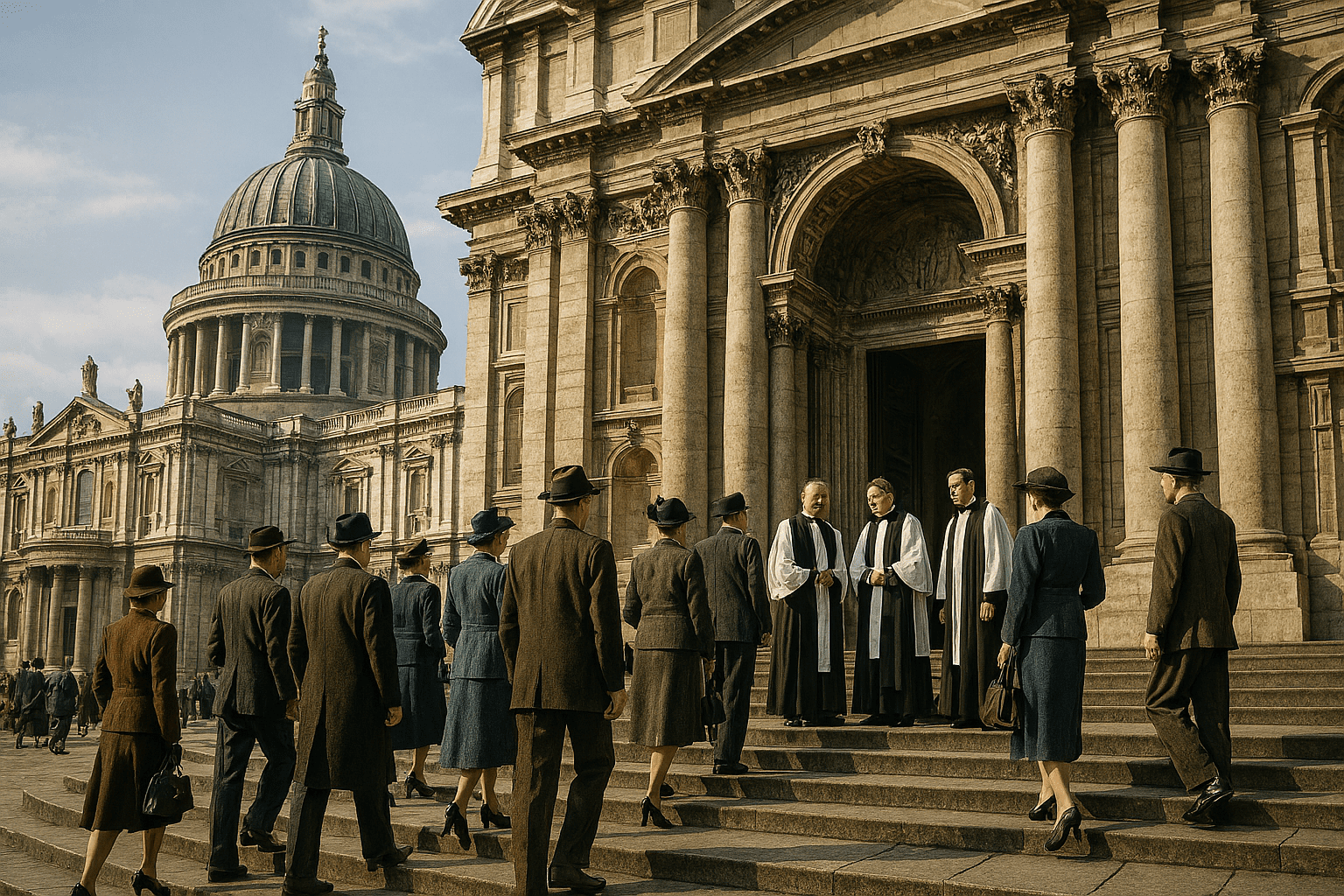
When famous Atheists attend church.
Some will say this is the aroma of Christ—the fragrance of the gospel finally penetrating post-Christian culture. But there has always been a category for those who participate in the culture of Christianity without possessing the life of Christ. Is it Christ drawing them, or merely the civilization He built?
When Cultural Christianity Is Codified
“Not everyone who says to me, ‘Lord, Lord,’ will enter the kingdom of heaven, but the one who does the will of my Father who is in heaven. On that day many will say to me, ‘Lord, Lord, did we not prophesy in your name, and cast out demons in your name, and do many mighty works in your name?’ And then will I declare to them, ‘I never knew you; depart from me, you workers of lawlessness.’”
—Matthew 7:21–23, ESV
Jesus spoke these words at the conclusion of the Sermon on the Mount, addressing not the openly hostile or the visibly pagan, but those who stood closest to the visible marks of the kingdom. These are insiders—people who prophesied, performed exorcisms, and worked miracles in Christ’s name. They possessed fluency in the language of faith, familiarity with the rituals of religion, and confidence in their proximity to the things of God. Yet Jesus declares them unknown. Their profession was orthodox. Their works were public. Their participation was active. But their hearts remained unregenerate, their relationship with Christ nonexistent, and their eternal standing catastrophic. This passage echoes the warning of Isaiah 29:13, where God condemns those who “draw near with their mouth and honor me with their lips, while their hearts are far from me,” a text Jesus Himself applies to the Pharisees in Matthew 15:8. The New Testament epistles carry this same concern into the life of the early church. John writes, “They went out from us, but they were not of us; for if they had been of us, they would have continued with us. But they went out, that it might become plain that they all are not of us” (1 John 2:19, ESV). There has always been a category for those who participate in the culture of Christianity without possessing the life of Christ.
This is not a marginal biblical concern. It is central to the warnings of Christ, the apostles, and the prophets. And in recent days, one of the world’s most famous atheists has named this category openly, giving explicit language to what Scripture has diagnosed for millennia: Christianity without Christ, belonging without believing, culture without conversion.
Richard Dawkins, the evolutionary biologist and author of The God Delusion, recently declared himself a “cultural Christian.” In a recent interview widely covered by UK media, he expressed admiration for Christian hymns, appreciation for the Christian moral ethos of Britain, and preference for Christianity over other religious traditions—while explicitly rejecting every spiritual claim of the Christian faith. He loves the aesthetic. He values the culture. He prefers the civilization. But he denies the gospel.
This is not an attack on Richard Dawkins, nor is it a critique of his character. Scripture calls believers to dismantle arguments, not people (2 Corinthians 10:4–5). Dawkins has simply articulated publicly what many have lived quietly for generations. His candor gives the church a clear window into a broader spiritual reality: the difference between admiring Christians, Christian ethos, or Christianity and being made alive by Christ. This article engages the idea he has given words to—cultural Christianity—because it reveals a pattern as old as the wheat and the tares, a distinction Scripture insists the church must maintain. The point is not to shame a man, but to clarify a category: Christianity appreciated for its beauty, stability, and moral coherence, yet untouched by the regenerating work of God. That distinction matters. And it is the distinction this article is pressing into.
Dawkins told interviewer Rachel Johnson on LBC, “I’m not a believer, but there is a distinction between being a believing Christian and a cultural Christian. I love hymns and Christmas carols, and I sort of feel at home in the Christian ethos, and I feel that we are a Christian country in that sense.” When asked about choosing between Christianity and Islam, he replied, “If I had to choose between Christianity and Islam, I’d choose Christianity every single time” (LBC interview, March 31, 2024). Yet he has been equally clear that he does not believe “a word” of Christianity’s spiritual claims.
Dawkins’ confession is remarkable not because it is new, but because it is now possibly openly respectable. What previous generations might have considered cognitive dissonance—claiming Christian identity while denying Christian truth—has become culturally coherent. One can be a “Christian” in the same way one might be “English” or “classical” in taste: a matter of cultural preference, not spiritual regeneration.
But what does Scripture say about those who honor the culture while rejecting the Christ?
The New Respectability of Cultural Christianity
Dawkins is not alone. In recent years, cultural Christianity has become openly respectable across multiple expressions. A surprising number of public figures—podcasters, actors, athletes, politicians—have begun attending church or speaking warmly about Christianity. Some who once mocked the faith now praise its moral clarity, its community, its beauty, or its stabilizing influence. At the same time, disillusioned by the shallowness of contemporary evangelicalism—its celebrity pastors, therapeutic preaching, and doctrinal drift—many are turning to older Christian traditions, drawn to the beauty of liturgy, the weight of history, the seriousness of ceremony, and the stability of structured worship.
Is this a new Great Awakening? Is the gospel finally breaking through in post-Christian culture? Or is this something older and more sobering—a return to the wide road, now redecorated with liturgy and readorned with theological vocabulary?
The danger is not the liturgy itself but what it might be asked to carry: moral relativism in vestments, postmodern assumptions dressed in ancient garb, cultural compromise seeking the appearance of orthodoxy without submitting to its demands.
Jesus warned of a similar danger in the parable of the sower, where some receive the word with joy but have no root, enduring only for a time before falling away when tribulation arises (Matthew 13:20–21). The seed that fell on rocky ground looked promising at first—immediate reception, visible growth—but it lacked the deep work of regeneration. Cultural Christianity operates in the same soil: visible participation without hidden transformation.
This is not new. This is the religion of the Pharisees. This is the faith of Simon the Magician, who believed and was baptized but whose heart remained captive to sin (Acts 8:13–23). This is the assembly James describes, where people claim faith but demonstrate no works, revealing that their faith is dead (James 2:14–26). And this is precisely what Jesus confronts in Matthew 7: religious activity divorced from relationship, works performed without the Father’s will, profession made without possession of Christ.
The problem is not aesthetic. The problem is not structural. The problem is not organizational. The problem is the deep-down brokenness of the human condition—what Scripture calls being “dead in the trespasses and sins” in which we once walked (Ephesians 2:1–5). And dead things do not revive themselves, no matter how beautifully the tomb is decorated.
Paul addresses this directly in Ephesians 2, describing the human condition before regeneration: “And you were dead in the trespasses and sins in which you once walked, following the course of this world, following the prince of the power of the air, the spirit that is now at work in the sons of disobedience—among whom we all once lived in the passions of our flesh, carrying out the desires of the body and the mind, and were by nature children of wrath, like the rest of mankind” (Ephesians 2:1–3). The solution is not human effort, religious participation, or liturgical engagement. The solution is divine intervention: “But God, being rich in mercy, because of the great love with which he loved us, even when we were dead in our trespasses, made us alive together with Christ—by grace you have been saved” (Ephesians 2:4–5). The verb Paul uses here—”made alive together with”—is synezōopoiēsen (συνεζωοποίησεν), a compound emphasizing that this is a divine act, not a human achievement.
When Apologetics Produces Its Opposite
There is a profound irony in Richard Dawkins’ confession that the church should not miss. For decades, Christian apologetics has argued precisely what Dawkins now affirms: that Christianity produces superior moral outcomes, that it provides intellectual coherence, that it builds stable civilizations, that it is the most reliable worldview among religious systems. The case has been made, argued, refined, and broadcast widely—that Christianity works, that it is reasonable, that it benefits society in measurable ways.
And Dawkins, exposed to these arguments for years, appears to have been persuaded. He now agrees that Christianity is culturally superior to its alternatives, that it produces better societies, that it offers moral grounding unavailable elsewhere. The apologetic case has succeeded—intellectually.
But intellectual persuasion is not regeneration. Cultural affirmation is not conversion. Agreement with Christianity’s benefits is not submission to Christ’s lordship. The apologetics movement may have won the argument unable to win the man.
This is not to condemn apologetics as a discipline. Paul reasoned in the synagogues (Acts 17:2). Peter commanded believers to give reasons for their hope (1 Peter 3:15). The church is called to demolish arguments raised against the knowledge of God (2 Corinthians 10:5). But there is a difference between defending the faith and marketing its benefits. There is a difference between answering objections to the gospel and building a case for Christianity’s usefulness. When apologetics emphasizes what Christianity does for civilization rather than what Christ does for sinners, it risks producing exactly what we now see: people persuaded of Christianity’s value who remain untouched by the gospel’s power.
Jesus did not come to make bad civilizations good. He came to make dead people alive. Paul did not preach a gospel of cultural improvement but of crucifixion and resurrection (1 Corinthians 1:23). The apostles did not argue that Christianity works better than paganism; they proclaimed that Christ died for sinners and rose from the dead, and that repentance and faith are required for salvation (Acts 2:38; 17:30-31).
When the church’s defense of the faith centers on Christianity’s cultural fruits rather than Christ’s redemptive work, it should not be surprised when people accept the former without the latter. Dawkins is not an anomaly. He is the logical conclusion of an apologetic that proves Christianity is beneficial while treating regeneration as optional.
The Biblical Diagnosis: Christianity Admired, Christ Rejected
Cultural Christianity is not a modern phenomenon. It is as old as Israel’s lip-service religion (Isaiah 29:13, Matthew 15:8–9, Mark 7:6–7), as common as the mixed multitude that left Egypt but never entered Canaan, and as persistent as the false professors Jesus warned would populate the visible church until the final judgment.
Jesus addressed this with Nicodemus, a man who possessed every external credential yet lacked the one thing necessary. “Truly, truly, I say to you, unless one is born again he cannot see the kingdom of God” (John 3:3). The word translated “born again”—anōthen (ἄνωθεν)—means both “again” and “from above,” emphasizing that this is a sovereign work of the Spirit, not culturally inherited or ritually conferred.
Jesus gave the most sobering description of this reality in Matthew 13, in the parable of the wheat and the tares. He describes a field where wheat and weeds grow together, indistinguishable in the early stages, both drawing from the same soil, both exposed to the same sun, both visible in the same field. The servants ask whether they should pull up the weeds immediately, but the master forbids it, explaining, “Let both grow together until the harvest, and at harvest time I will tell the reapers, ‘Gather the weeds first and bind them in bundles to be burned, but gather the wheat into my barn’” (Matthew 13:30). Jesus later explains that the field is the world, the good seed represents the sons of the kingdom, and the weeds represent the sons of the evil one (Matthew 13:38). The separation comes not at the moment of visible profession, but at the final judgment.
He gives similar warnings in the parable of the sheep and the goats (Matthew 25:32) and in the reality John describes: “They went out from us, but they were not of us” (1 John 2:19). The verb “went out”—exēlthon (ἐξῆλθον)—emphasizes the decisive action of departure that revealed, rather than created, their status as outsiders. Cultural Christianity, then, is not an anomaly. It is a persistent reality Scripture repeatedly warns against.
Why This Matters for the Church
The church is called to preach the gospel plainly, without softening its offense or widening its narrow gate to accommodate the crowd. Jesus Himself said, “Enter by the narrow gate. For the gate is wide and the way is easy that leads to destruction, and those who enter by it are many. For the gate is narrow and the way is hard that leads to life, and those who find it are few” (Matthew 7:13–14). The narrow way is not widened by popularity. The church is not strengthened when unbelievers admire it from a distance. The church is strengthened when God raises the dead, when hearts of stone become hearts of flesh, when those who were far off are brought near by the blood of Christ.
This means the church must resist the temptation to celebrate cultural Christianity as if it were evidence of gospel success. When public figures speak warmly of Christianity, the church should neither mock them nor baptize their statements as conversions. Instead, the church should continue to preach the gospel clearly, trusting that God alone gives life, God alone grants repentance, and God alone draws sinners to Christ. The verb “draws”—helkō (ἕλκω)—that Jesus uses in John 6:44 is significant: “No one can come to me unless the Father who sent me draws him.” This is not mere invitation. It is divine compulsion, sovereign grace, effectual calling. Apart from this work, no amount of cultural Christianity will produce spiritual life.
The church must also recognize that cultural Christianity, while spiritually insufficient, is not spiritually neutral. It can function as inoculation against the gospel, giving people the false assurance that they are right with God because they admire Christian values, attend Christian services, or participate in Christian culture. This was Jesus’ warning in Matthew 7: many will claim relationship with Him based on religious activity, only to hear Him declare, “I never knew you.” The word “knew”—egnōn (ἔγνων)—is not academic knowledge but relational intimacy, covenant knowing. Cultural Christianity can give the appearance of belonging while masking the absence of true union with Christ.
Saying the Quiet Part Out Loud
Richard Dawkins has named openly what Scripture has diagnosed for millennia. Christianity is beautiful, beneficial, civilizationally rich, morally grounding, and culturally comforting. These observations are not false. Christianity has shaped Western civilization in profound ways. The culture Christianity built is genuinely valuable.
But none of that is salvation.
And so, the church returns to the words of Jesus, spoken not to pagans but to insiders, not to the openly hostile but to the religiously engaged, not to those far from the culture of faith but to those standing at its very center:
“Not everyone who says to me, ‘Lord, Lord,’ will enter the kingdom of heaven, but the one who does the will of my Father who is in heaven. On that day many will say to me, ‘Lord, Lord, did we not prophesy in your name, and cast out demons in your name, and do many mighty works in your name?’ And then will I declare to them, ‘I never knew you; depart from me, you workers of lawlessness.’” (Matthew 7:21–23)
Jesus’ warning echoes across the centuries. Cultural Christianity—admired, respected, culturally useful—remains what it has always been: participation without possession, profession without relationship, works without the Father’s will. The quiet part is now spoken aloud, but the gospel’s answer remains unchanged.
Only God gives life. Only God calls effectually. Only God makes the dead live. The church’s task is neither to celebrate cultural Christianity as progress nor to mock it as hypocrisy, but to continue preaching the gospel with clarity, trusting that God will do what only God can do.
“But God, being rich in mercy, because of the great love with which he loved us, even when we were dead in our trespasses, made us alive together with Christ—by grace you have been saved.” (Ephesians 2:4–5)
Editor’s Note: This article examines the biblical category of cultural Christianity—participation in Christian culture without regeneration by the Holy Spirit. Scripture is clear that such a category exists (Matthew 7:21-23; 1 John 2:19), and the church must maintain the distinction between profession and possession, between admiration and conversion.
However, we cannot see hearts. We cannot know with certainty who possesses genuine faith and who does not, except in cases where individuals openly confess their unbelief—as Richard Dawkins has done—or where long patterns of life contradict profession. Even then, we speak carefully, remembering that the thief on the cross entered the kingdom in his final moments (Luke 23:43), that Paul was Christ’s enemy before becoming His apostle (Acts 9), and that God’s Word never returns void but accomplishes His purposes (Isaiah 55:11).
The church’s task is not to scrutinize hearts or pronounce final judgments. Our task is to preach the gospel clearly, to speak truth in love (Ephesians 4:15), to walk uprightly, and to let our light shine before men (Matthew 5:16). We do not know whom God will regenerate, when He will do so, or how His Word is working in ways invisible to us. What we do know is this: God alone gives life, God alone grants repentance, and God alone draws sinners to Christ. Our responsibility is faithfulness in proclamation. The results belong to Him.