
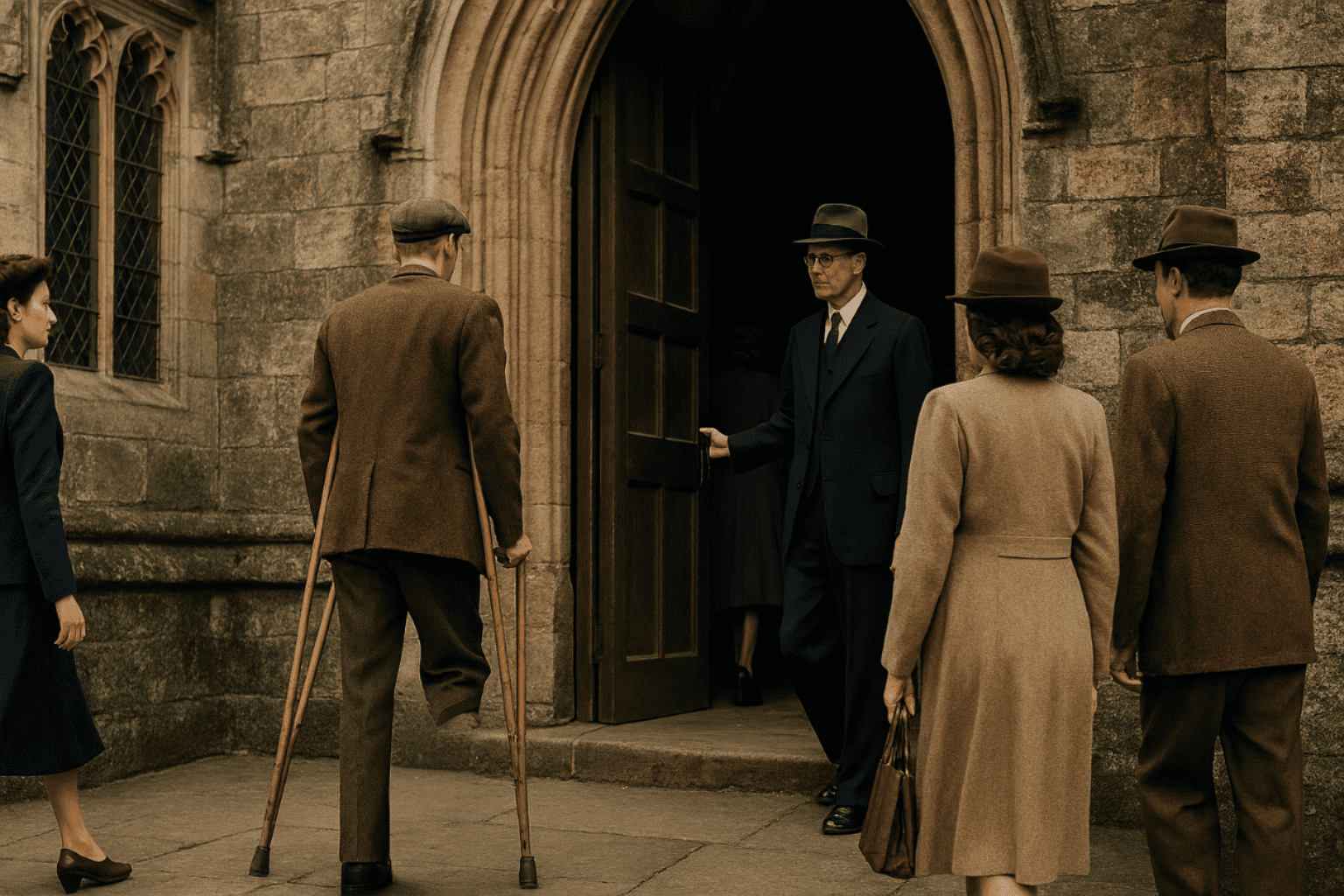
We are unfit for God’s presence.
It feels harsh at first—enough to make us recoil. But Leviticus 21 is not about God rejecting the broken. It’s about God Himself, about His holiness. The standard is not set by men, nor is it aimed at shaming them. He is revealing the nature of His own holiness, and what it demands of anyone who would draw near to Him. Jesus is, most staggeringly, the righteousness that the Levitical system demanded but could never produce
A Sustained Theological Curriculum, Designed to Instruct
“And the LORD spoke to Moses, saying, ‘Speak to Aaron, saying, None of your offspring throughout their generations who has a blemish may approach to offer the bread of his God. For no one who has a blemish shall draw near, a man blind or lame, or one who has a mutilated face or a limb too long, or a man who has an injured foot or an injured hand, or a hunchback or a dwarf or a man with a defect in his sight or an itching disease or scabs or crushed testicles. No man of the offspring of Aaron the priest who has a blemish shall come near to offer the LORD’s food offerings; since he has a blemish, he shall not come near to offer the bread of his God. He may eat the bread of his God, both of the most holy and of the holy things, but he shall not go through the veil or approach the altar, because he has a blemish, that he may not profane my sanctuaries, for I am the LORD who sanctifies them.’”
—Leviticus 21:16–23, ESV
The passage does not ease the reader in. It lists conditions. It names them without softening: blindness, lameness, mutilation, dwarfism, crushed testicles. The priest bearing any of these may eat the holy food. He may remain in the Aaronic line. He retains his identity and his share. But he may not draw near. He may not pass through the veil. He may not approach the altar. The restriction is announced without apology, and the reason given is not moral failure, not divine disgust, not punishment—but sanctity. “He shall not go through the veil or approach the altar, because he has a blemish, that he may not profane my sanctuaries, for I am the LORD who sanctifies them.”
Modern readers may recoil from this passage. It feels exclusionary, arbitrary, even cruel. But that reaction is the product of reading Leviticus 21 in isolation from the theological curriculum it belongs to. God is not, in this passage, revealing His opinion of disabled bodies. He is revealing the nature of His own holiness, and what it demands of anyone who would draw near to Him.
The question is not, Why does God exclude? The question is, What is God teaching?
What Kind of God Does Leviticus 21 Reveal?
The early books of the Old Testament are not primitive religion, nor a collection of arbitrary ritual regulations inherited from ancient Near Eastern culture. They are, rather, a sustained theological curriculum, designed to teach a people who had spent four hundred years in Egypt—surrounded by polytheism, animism, and a thoroughly disenchanted view of the divine—what it means that the God of Abraham, Isaac, and Jacob is holy. The entire Levitical system—priests, sacrifices, purity distinctions, clean and unclean categories, the sanctuary’s layered zones of access, the veil, the Day of Atonement—argues a single coherent truth: God is holy, humanity is not, and only God Himself can make us holy enough to draw near.
Leviticus 21 is not about God rejecting imperfect people. It is about God revealing the perfection required to stand in His presence—a perfection ultimately provided not by human effort, priestly lineage, or bodily wholeness, but only in Christ. The point is not that God is distant or fragile. The point is that God is holy, and we are not, and therefore only God Himself can make us fit to draw near.
What Is the Sanctuary, and What Does It Say?
To read Leviticus rightly, one must first understand what the sanctuary is. The tabernacle—and later the temple—is a symbolic Eden, a concentrated microcosm of unbroken creation. Its spatial logic moves from the outer court to the holy place to the holy of holies, each zone representing a deeper proximity to God’s presence, each guarded by increasingly strict conditions of access. The veil at the innermost threshold is not a bureaucratic boundary. It is a theological statement: humanity, east of Eden and marked by the fall, cannot simply walk into God’s presence. Approach requires mediation, preparation, and a holiness that no fallen creature possesses by nature.
The priest standing before the altar represents idealized representative humanity—not any individual’s personal worth, but the symbolic wholeness that God’s presence demands. When Leviticus 21 restricts the blemished priest from approaching the veil, it is not passing judgment on his value as a person or as a servant of God. It is protecting the sanctuary’s message. The Hebrew word for “profane”—chalal (חָלַל)—carries the sense of piercing or desecrating what is set apart, treating the holy as though it were common. God’s concern in this passage is the integrity of what the sanctuary proclaims. A blemished priest approaching the altar would send a false signal—that God’s presence accommodates disorder, that holiness is negotiable, that the wholeness of Eden is not actually what stands before them.
Why Does God Teach Holiness Through Symbols Rather Than Abstractions?
Israel had no theological vocabulary for what they were being given. They had no Scripture, no developed doctrine of atonement, no framework for understanding transcendence. They had the memory of plagues, the testimony of a parted sea, and the terrifying voice from the mountain. God’s pedagogy meets them where they are. He teaches through embodied symbols—through sight, space, touch, and ritual—because these are the categories available to a people still learning that He is categorically unlike anything they have known.
The word “holy”—qadosh (קָדוֹשׁ)—does not mean morally superior in some generic sense. It means set apart, marked off from ordinary use, belonging to a different order of reality entirely. When God declares at the close of Leviticus 21, “I am the LORD who sanctifies them,” He is not simply asserting authority. He is revealing that holiness flows from Him outward—that the sanctuary is holy because He makes it holy, that the priests are holy because He sets them apart, that the entire system exists to teach Israel that the Source of holiness is God Himself, and that it flows in one direction only.
Clean and unclean distinctions teach the difference between life and death. Sacrifices teach substitution—that something must die so the worshiper may live. Priests teach mediation—that no one approaches God directly. The veil teaches separation. The Day of Atonement teaches that access is granted only through blood, only once a year, only by one man, and only after exhaustive preparation. The symbols are not for God’s sake. They are for ours. They are the theological grammar by which God teaches a newly-formed nation to think rightly about His nature—and about their own.
What Does the Levitical System Reveal About Humanity?
The cumulative witness of the Levitical system—its rituals, its restrictions, its careful gradations of holiness—is that humanity is not merely morally flawed. We are unfit for God’s presence. This is the relentless argument of the text. Adam is expelled from Eden. Israel cannot approach the mountain without preparation, and even then only Moses ascends. Moses himself cannot see God’s face without being hidden in the cleft of the rock. The high priest enters the holy of holies only once a year, only with blood, only after days of ritual cleansing—a preparation so exacting that Leviticus devotes two full chapters to its administration.
The Old Testament is not being pessimistic about human nature. It is being accurate. Sin is not merely behavioral; it is a condition of unfitness for the presence of the Living God. The Old Testament’s repeated, embodied message is this: you cannot come near unless someone goes before you. The system is not designed to produce despair. It is designed to produce longing—the kind of longing that will recognize its answer when He arrives.
Every sacrifice in the Levitical system is a visual sermon aimed at the precise shape of that answer. The animal must be without blemish, because the substitute must be perfect. God makes this explicit in Leviticus 22:17–25, where He forbids the offering of any animal that is blind, injured, maimed, or otherwise defective—whether from the hand of an Israelite or a foreigner. “You shall not offer anything that has a blemish, for it will not be acceptable for you” (Leviticus 22:20, ESV). The restriction on the priest and the restriction on the offering run in parallel: not only must the one who approaches be whole, the one who is offered must be whole. God is teaching the same truth from two directions at once—pressing Israel to understand that His holiness is not a preference or a standard among standards. It is the defining reality of His nature, and everything that comes near Him, or is given to Him, must reflect that reality. Blood must be shed, because sin demands death. The priest must mediate, because sinners cannot approach God directly. The altar must be pure, because God’s presence cannot be defiled. The Levitical code is not offering a solution to human unholiness. It is showing the shape that any solution must take—and in doing so, it is pointing forward with relentless insistence.
There is one more thing the Levitical system reveals, and it is the most searching of all. The restriction in Leviticus 21 falls on the blemished priest—but the unblemished priest who did approach the altar was no less a sinner. His physical wholeness qualified him symbolically; it did not make him actually fit for God’s presence. He still required cleansing. He still offered blood. He still could not enter the holy of holies without atonement that was not his own. The symbol of wholeness was never a claim that any son of Aaron stood before God on his own merit. It was a picture of what God’s holiness requires—a picture designed to press the question that the whole system could not answer: Where is the priest who is not only symbolically whole, but actually holy? Where is the sacrifice that does not merely represent perfection, but is perfection? The blemished priest standing outside the veil and the unblemished priest standing before the altar were, before God, in the same condition. Without atonement, without blood, without a mediator not of their own making, neither could survive the presence of the Holy One. Leviticus 21 is not, finally, a passage about disabled bodies. It is a passage about every human body—and every human soul—standing east of Eden, unfit for the presence of God, and waiting for a wholeness that only God Himself can provide.
Why Does the New Testament Call the Old System a Shadow?
The author of Hebrews understands the Levitical logic better than any other New Testament writer. Commenting on the sanctuary and its priesthood, he writes: “They serve a copy and shadow of the heavenly things” (Hebrews 8:5, ESV). The word “shadow”—skia (σκιά)—is not a dismissal. A shadow is a real thing; it is cast by something real. The Levitical system is not false religion. It is real theology, faithfully pointing toward the substance that has not yet arrived. “For since the law has but a shadow of the good things to come instead of the true form of these realities, it can never, by the same sacrifices that are continually offered every year, make perfect those who draw near” (Hebrews 10:1, ESV).
The repetition is the point. The annual sacrifice, the repeated washings, the ongoing priestly restrictions—these are not weaknesses in the system. They are the system’s own testimony that it is not the end. They generate the question that the entire Old Testament exists to press: When will something come that does not have to be repeated? Paul answers with characteristic economy: “These are a shadow of the things to come, but the substance belongs to Christ” (Colossians 2:17, ESV). The Levitical restrictions are theological scaffolding, erected around the gospel so that when the gospel arrives, it can be recognized for what it is.
How Does Christ Fulfill What the Levitical System Demands?
Christ does not set aside the holiness demands of Leviticus 21. He fulfills them. He is the priest who has no blemish—”holy, innocent, unstained, separated from sinners, and exalted above the heavens” (Hebrews 7:26, ESV). He is the sacrifice without defect—”a lamb without blemish or spot” (1 Peter 1:19, ESV). He is the temple itself—God’s presence dwelling in human flesh, so that John can write that the Word “tabernacled among us”—eskēnōsen (ἐσκήνωσεν)—pitching His tent in the midst of His people as God once pitched His in the wilderness (John 1:14). When He speaks of the destroyed and raised temple, He speaks of His own body (John 2:19–21). And He is, most staggeringly, the righteousness that the Levitical system demanded but could never produce: “so that in him we might become the righteousness of God” (2 Corinthians 5:21, ESV).
The Old Testament says: You must be holy to come near. The New Testament says: Christ makes you holy so you can come near. The entire Levitical curriculum—its priests and sacrifices, its clean and unclean, its veils and altars and Day of Atonement—exists to teach Israel and us the categories we need in order to understand what Christ has done. He has not relaxed the standard. He has met it, fully and finally, on behalf of all who belong to Him.
What Happens to the Restrictions Once Christ Arrives?
They collapse—not because God has changed His mind about holiness, but because the basis for restriction has been permanently removed. When Jesus breathes His last on the cross, “the curtain of the temple was torn in two, from top to bottom” (Matthew 27:51, ESV). The veil—that thick, embroidered barrier that declared the separation between a holy God and an unfit humanity—is split open. Not from the bottom up, as a man might tear it. From the top down. The tearing is God’s own act, God’s own declaration that the ground of separation has been dealt with. The restriction of Leviticus 21 was never about God’s desire to remain distant. It was about what human unholiness does in the presence of divine holiness. When that unholiness is dealt with—finally, completely, in the body of Christ—the veil has nothing left to protect.
The blind and lame come to Jesus in the temple, and He heals them (Matthew 21:14). The very bodies excluded from the altar in Leviticus 21 are the first to be welcomed and restored when the true Priest enters the true Temple. The Aaronic qualifications are not reinstated for the church. Instead, the church becomes “a royal priesthood, a holy nation, a people for his own possession” (1 Peter 2:9, ESV)—not because the standard has been lowered, but because the one true Priest has met it for all who are united to Him. Access is now granted not with fear, but with bold, unashamed confidence—parrēsia (παρρησία)—to draw near to the throne of grace (Hebrews 10:19–22; 4:16, ESV). The symbolic system has served its purpose. The reality has arrived.
Holiness Demanded Distance. Love Closed It.
Leviticus 21 is not a blemish-based exclusion. It is a holiness-based revelation. The God who will not allow a blemished priest through the veil is not embarrassed by imperfect bodies, not hostile to the disabled, not constructing a merit system for those whose physical condition happens to conform. He is teaching a nation—and through that nation, a world—that His presence is whole, His holiness is real, and His nearness requires a perfection that no fallen human being possesses.
He teaches this truth not to close the door, but to prepare His people to recognize the One who would open it. Every blemished priest who ate the holy food and stood outside the veil was a living parable—sustained by God, belonging to God, yet unable to approach the innermost presence on his own terms. The parable finds its resolution in Christ, who enters not through a veil of embroidered linen but through His own flesh (Hebrews 10:20), not with the blood of animals but with His own, not once a year but once for all.
The God of Leviticus 21 is not a God who turns away the broken. He is a God whose holiness is so blazing, so life-giving, so utterly real that He refused to let anything less than perfect righteousness stand between Himself and His people. And then, unwilling to leave us outside the veil forever, He provided that righteousness Himself. The point is not that God is distant or fragile. The point is that God is holy, and we are not, and therefore only God Himself can make us fit to draw near. In Christ, He has done exactly that.
Editor’s Note: Some will read Leviticus 21 and hear discrimination. That reaction is understandable when Scripture is approached without the holiness framework God Himself provides—but it misses the passage’s actual argument entirely. Leviticus 21 is not a statement about the worth of disabled bodies. It is a revelation of the perfection required to stand in the presence of a holy God. The restriction is symbolic, not moral; pedagogical, not punitive.
And if the question lingers about God’s heart toward the disabled, the Gospels answer it plainly. The blind, the lame, and the broken come to Christ, and He heals them. The very bodies that could not approach the altar in Leviticus are welcomed and restored by the true Priest in the true Temple. What Leviticus symbolized as required, Christ provides as gift—a wholeness He secures for all who belong to Him, in bodies that will one day be fully and finally made new.