Wild yeast in bread is good, right?
Why does Scripture repeatedly distinguish leavened from unleavened—sometimes forbidding it, sometimes commanding it, sometimes wielding it as a metaphor for corruption, and sometimes as a picture of the kingdom itself?
That Which Permeates, Transforms, and Works Invisibly from Within
“You shall not offer the blood of my sacrifice with anything leavened…”
— Exodus 23:18, ESV
Before Israel ever reached Sinai, before the tabernacle stood, before the priesthood was consecrated, God drew a line between leavened and unleavened. Not because He disliked fermentation. Not because He preferred flatbread. But because the symbol mattered. Because the story He was telling required a people who understood the difference between the old life carried forward and the new life begun by God alone. And if we are to understand why this distinction echoes across the entire canon—from the haste of Egypt to the holiness code of Leviticus to the sharp warnings of Jesus and the pastoral urgency of Paul—we must begin where God began: with bread that carries no memory of yesterday.
So what is God doing with this symbol? Why does Scripture repeatedly distinguish leavened from unleavened—sometimes forbidding it, sometimes commanding it, sometimes wielding it as a metaphor for corruption, and sometimes as a picture of the kingdom itself? If words have meaning, then this one—leaven—carries a theological weight that begins in Egypt, matures at Sinai, resurfaces in the prophets, and is finally sharpened by Christ and His apostles. To understand it, we must follow the symbol from its first appearance to its final application, and we must resist the temptation to flatten it into a single meaning before Scripture has finished speaking.
Where the Symbol Begins: Exodus and the Break with Egypt
The first time God commands unleavened bread, the context is not worship. It is departure.
“They baked unleavened cakes of the dough that they had brought out of Egypt, for it was not leavened, because they were thrust out of Egypt and could not wait, nor had they prepared any provisions for themselves.” (Exodus 12:39, ESV)
Moses records this detail not as an afterthought but as an explanation. Israel did not eat unleavened bread because God had issued a dietary preference. They ate it because they were thrust out—the Hebrew word for this forced departure, garash (גָּרַשׁ), carries the force of expulsion, of being driven out with no option to linger. There was no time for the dough to rise. There was no opportunity to carry yesterday’s ferment into tomorrow’s bread. The urgency of God’s deliverance left no room for the typical process.
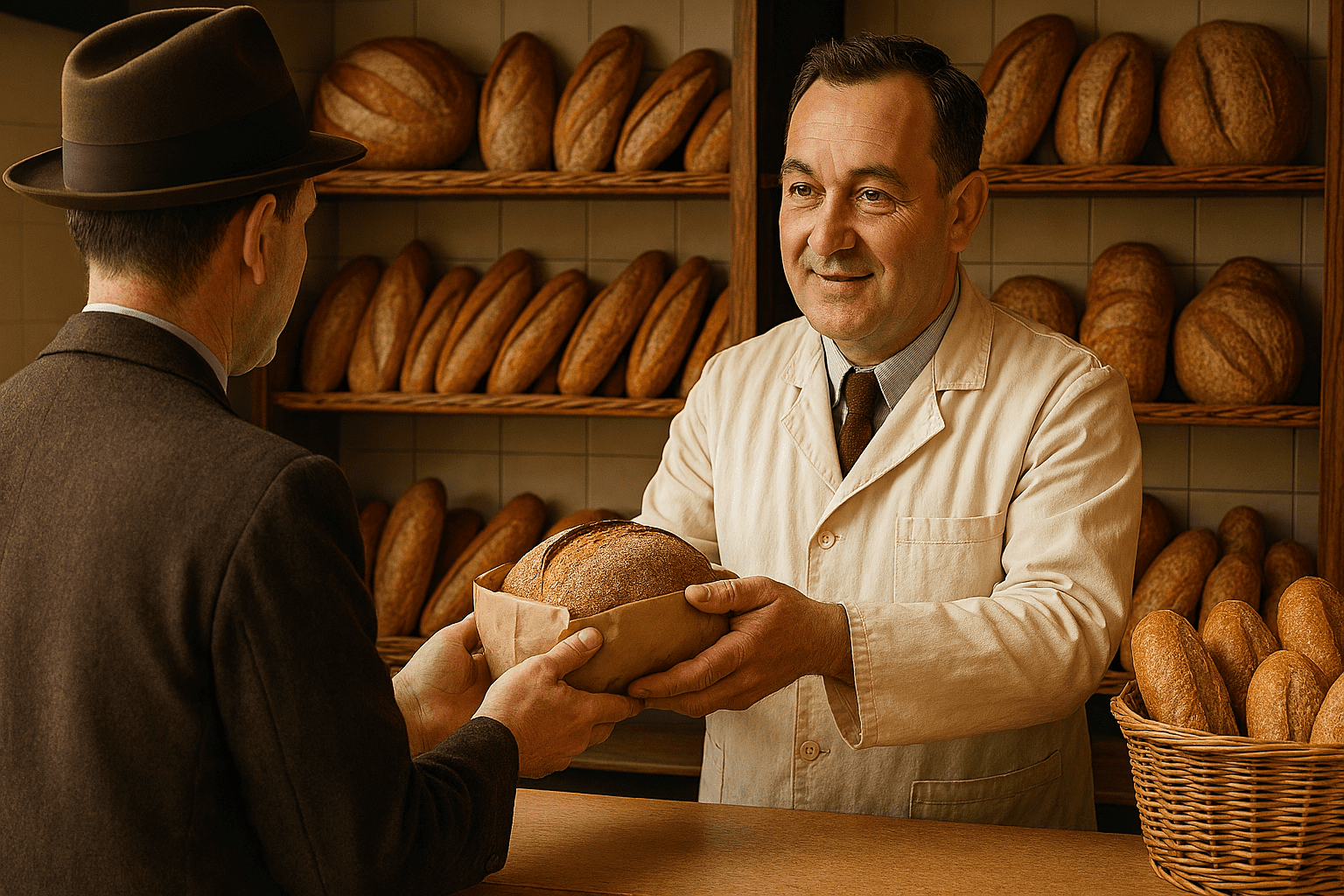
And this matters because of how leaven actually worked in the ancient world. Leaven was not a sealed packet of commercial yeast. It was a piece of old dough—se’or (שְׂאֹר)—saved from yesterday’s batch, preserved so that its living cultures could ferment today’s flour. Every loaf of leavened bread was, in a very real sense, bread with a memory. It carried the biological continuity of what came before. It was the old life baked into the new.
So when God commanded Israel to eat bread without leaven, He was commanding bread without memory. Bread with no biological link to Egypt. Bread that began fresh, that owed nothing to the old batch, that carried no trace of the former life. Unleavened bread became the edible symbol of God’s decisive break with Israel’s past—the bread of new beginnings.
And God did not leave this as a one-time occurrence. He institutionalized the break: “Seven days you shall eat unleavened bread. On the first day you shall remove leaven out of your houses, for if anyone eats what is leavened, from the first day until the seventh day, that person shall be cut off from Israel” (Exodus 12:15, ESV). The penalty for violating this command was not a fine or a rebuke. It was excommunication. To eat leavened bread during Passover was to declare, symbolically, that you had not left Egypt—that you still carried the old life, the old influence, the old ferment. And such a person had no place among the people God had made new.
This was never about crumbs. It was about identity.
Sinai: Unleavened Bread Becomes a Holiness Marker
By the time we reach Exodus 23:18, the symbol has matured beyond departure and into worship. “You shall not offer the blood of my sacrifice with anything leavened” is not a Passover regulation—it is a sacrificial principle. God is now legislating what may approach His altar, and leaven is excluded.
Why? Because the altar represents purity, atonement, God’s nearness, and holiness without mixture. The Hebrew term for leaven in its fermented state—chametz (חָמֵץ)—carries connotations of souring, of something that has undergone a process of internal change through external influence. It is dough that has been acted upon by a foreign agent and transformed from within. And this is precisely what God will not permit at His altar.
The sacrifice cannot be paired with a symbol of the old corruption. The holy cannot be mixed with the old ferment. Leviticus 2:11 makes this explicit: “No grain offering that you bring to the LORD shall be made with leaven, for you shall burn no leaven nor any honey as a food offering to the LORD” (ESV). The grain offering—the minchah, which represented the worshiper’s devotion and daily sustenance offered back to God—had to come without leaven. The worshiper could not bring the symbol of the old process into the presence of the Holy One.
This is the same logic that governs the broader holiness code. God repeatedly forbids mixture in worship and in life: clean and unclean must not be confused (Leviticus 10:10), holy and common must not be blended, and the worship of Yahweh must not absorb the practices of the surrounding nations. The issue was never culinary preference. It was ritual coherence—the visible, tangible insistence that what belongs to God must not carry the residue of what does not.
There is, however, one striking exception. Leviticus 7:13 prescribes leavened bread alongside the peace offering of thanksgiving: “With the sacrifice of his peace offerings for thanksgiving he shall bring his offering with loaves of leavened bread” (ESV). Does this contradict the prohibition? Not at all. The peace offering was not burned on the altar—it was eaten by the worshiper in a communal meal. Leavened bread could accompany the fellowship meal because it was not entering God’s consuming fire. The distinction was precise: what ascends to God must be unleavened; what is shared among His people at the table of fellowship could include the bread of ordinary life. God was not declaring leaven evil. He was declaring it unfit for one specific purpose—direct offering to Himself.
The Prophets: Leaven as Moral and Communal Corruption
By the time we reach the prophets, the symbol expands from ritual regulation into moral metaphor. But to feel the full force of what the prophets are doing, we need to understand what leaven actually is—not as a theological abstraction, but as a biological reality.
Wild yeast is everywhere. It lives on the surface of grain, drifts through the air, clings to human hands. When flour meets water and is left to sit, these invisible organisms begin to feed on the sugars in the grain, producing carbon dioxide and organic acids that cause the dough to rise and develop its characteristic tang. Add salt—which regulates the fermentation, strengthens the gluten, and tempers the wild culture’s pace—and the result is the beautifully risen, complex loaf that has sustained civilizations for millennia. Leavened bread is not inferior bread. It is, in many ways, bread at its fullest expression: rich in flavor, layered in texture, alive with the slow work of time and culture.
And that is precisely what makes it so potent as a symbol. The very qualities that make leaven good in the kitchen—its invisibility, its patience, its capacity to transform an entire batch from within—are the qualities that make it dangerous as a metaphor for sin. Corruption does not announce itself. It works quietly, thoroughly, and given enough time and warmth, it changes everything it touches. The prophets understood this. Leaven becomes their shorthand for corruption that spreads, idolatry that permeates a community, and compromise that multiplies unchecked.
Hosea speaks of Israel’s leaders as those who inflame the people like an oven: “They are all adulterers; they are like a heated oven whose baker ceases to stir the fire, from the kneading of the dough until it is leavened” (Hosea 7:4, ESV). The image is devastating. The leaders have set the conditions for corruption and then stepped back to let it rise on its own. The leaven does not need constant attention—it only needs time and warmth. Left alone, it will transform the entire batch. Hosea’s audience would have understood immediately: the old ferment of idolatry and injustice, once introduced, does its work silently and thoroughly.
Amos condemns Israel’s worship as polluted offering: “Offer a sacrifice of thanksgiving of that which is leavened” (Amos 4:5, ESV). The irony is biting—and deliberately so. Amos is not recording a liturgical instruction; he is mocking Israel’s self-deceived piety. They have so confused their worship that they bring the very thing God excluded from His altar and call it devotion. They have mixed the holy with the corrupt and called the mixture acceptable. Malachi echoes this trajectory, indicting priests who offer defiled food on God’s altar and who “sniff at” the sacrificial system with contempt (Malachi 1:7–13). The prophetic witness is consistent: do not bring the old corruption into the presence of the Holy One. The symbol that began at the Exodus has become a diagnostic for Israel’s spiritual condition.
Jesus: Leaven as Influence—Good and Bad
Jesus sharpens the symbol in two directions, and both depend on the same core meaning: leaven is that which permeates, transforms, and works invisibly from within.
In its negative application, Jesus warns His disciples plainly: “Watch and beware of the leaven of the Pharisees and Sadducees” (Matthew 16:6, ESV). The disciples, characteristically, think He is talking about bread. He is not. Matthew records that “then they understood that he did not tell them to beware of the leaven of bread, but of the teaching of the Pharisees and Sadducees” (Matthew 16:12, ESV). Luke’s parallel identifies this leaven specifically as hypocrisy (Luke 12:1). The Pharisees’ teaching was not overtly heretical in every instance—it was subtly corrupting. It worked like leaven: introduced quietly, spreading gradually, transforming the whole from within until what appeared to be faithful observance was in fact spiritual rot. The old ferment had been baked into new-looking bread.
But Jesus also employs the symbol positively, and this is where many readers stumble. “The kingdom of heaven is like leaven that a woman took and hid in three measures of flour, till it was all leavened” (Matthew 13:33, ESV). Here the Greek word for leaven—zumē (ζύμη)—carries no negative connotation. The kingdom works like leaven: it permeates, it transforms, it cannot be stopped once introduced. The same invisible, thoroughgoing power that makes leaven dangerous as a symbol of corruption makes it potent as a symbol of the kingdom’s unstoppable advance.
Jesus is not contradicting Moses. He is demonstrating that leaven, as a symbol, describes a process—the process of hidden, pervasive, total transformation. Whether that transformation is corruption or kingdom growth depends entirely on what has been introduced into the dough. This is why careful readers must resist collapsing every biblical reference to leaven into a single negative meaning. The symbol is flexible, but it is never random. In worship, leaven represents corruption that must be excluded. In community, it represents influence that must be discerned. In the kingdom, it represents transformation that cannot be resisted.
Paul: The Church as the Unleavened People
Paul ties the entire biblical arc together with pastoral precision and unmistakable Exodus logic.
“Cleanse out the old leaven that you may be a new lump, as you really are unleavened. For Christ, our Passover lamb, has been sacrificed. Let us therefore celebrate the festival, not with the old leaven, the leaven of malice and evil, but with the unleavened bread of sincerity and truth.” (1 Corinthians 5:7–8, ESV)
The verb Paul uses—ekkatharate (ἐκκαθάρατε)—is an imperative: cleanse out thoroughly. It is not a suggestion but a command, and its force echoes God’s original instruction to Israel: remove the leaven from your houses (Exodus 12:15). Paul’s logic is pure Exodus, transposed into the life of the church. Christ is the Passover lamb—therefore the church is the Passover people. And the Passover people must be unleavened. The old leaven—the sin tolerated in the Corinthian community, the corruption carried forward from the old life—must be removed, because its presence contradicts the identity God has given them.
Notice Paul’s remarkable assertion: “as you really are unleavened.” He does not say the Corinthians should try to become unleavened. He says they already are unleavened—positionally, in Christ. The imperative to cleanse out the old leaven flows from the indicative of what God has already made them. Because Christ has been sacrificed, the old life has been broken. The church is the people who have left Egypt. And therefore the old dough—the old corruption, the old ferment, the old life carried forward—has no place among them.
Paul is doing exactly what God did at the Exodus. He is insisting that the people of God must not carry the old batch into the new life. The parallel is not incidental—Paul constructs it deliberately, drawing on the same sacrificial and ritual logic that governed Israel’s relationship to leaven from the beginning. The church is not merely a community that avoids sin as a matter of moral improvement. It is, by virtue of Christ’s sacrifice, the Unleavened People—a community whose very identity is defined by the decisive break God has made between the old and the new.
Bread on the Altar
When God said, “You shall not offer the blood of my sacrifice with anything leavened,” He was not policing recipes. He was protecting the story—a story in which God brings a people out of the old world, breaks their continuity with corruption, forms them into a consecrated community, and calls them to worship without mixture.
That story begins with unleavened bread baked in the haste of Egypt, where there was no time for the old dough to do its work. It matures at Sinai, where what ascends to God must carry no residue of the old ferment. It deepens through the prophets, who diagnose Israel’s corruption as leaven introduced into the life of the covenant community. It is sharpened by Jesus, who warns against the leaven of false teaching and then reveals that the kingdom itself works with the same pervasive, transforming power. And it reaches its fullest expression in Paul, who declares that the church—purchased by the blood of the true Passover lamb—is and must be an unleavened people.
Because words have meaning. And this one—leaven—tells the story of a God who refuses to let the old life rise again in the people He has made new.
…so, go ahead and make a loaf of sourdough. I am.