
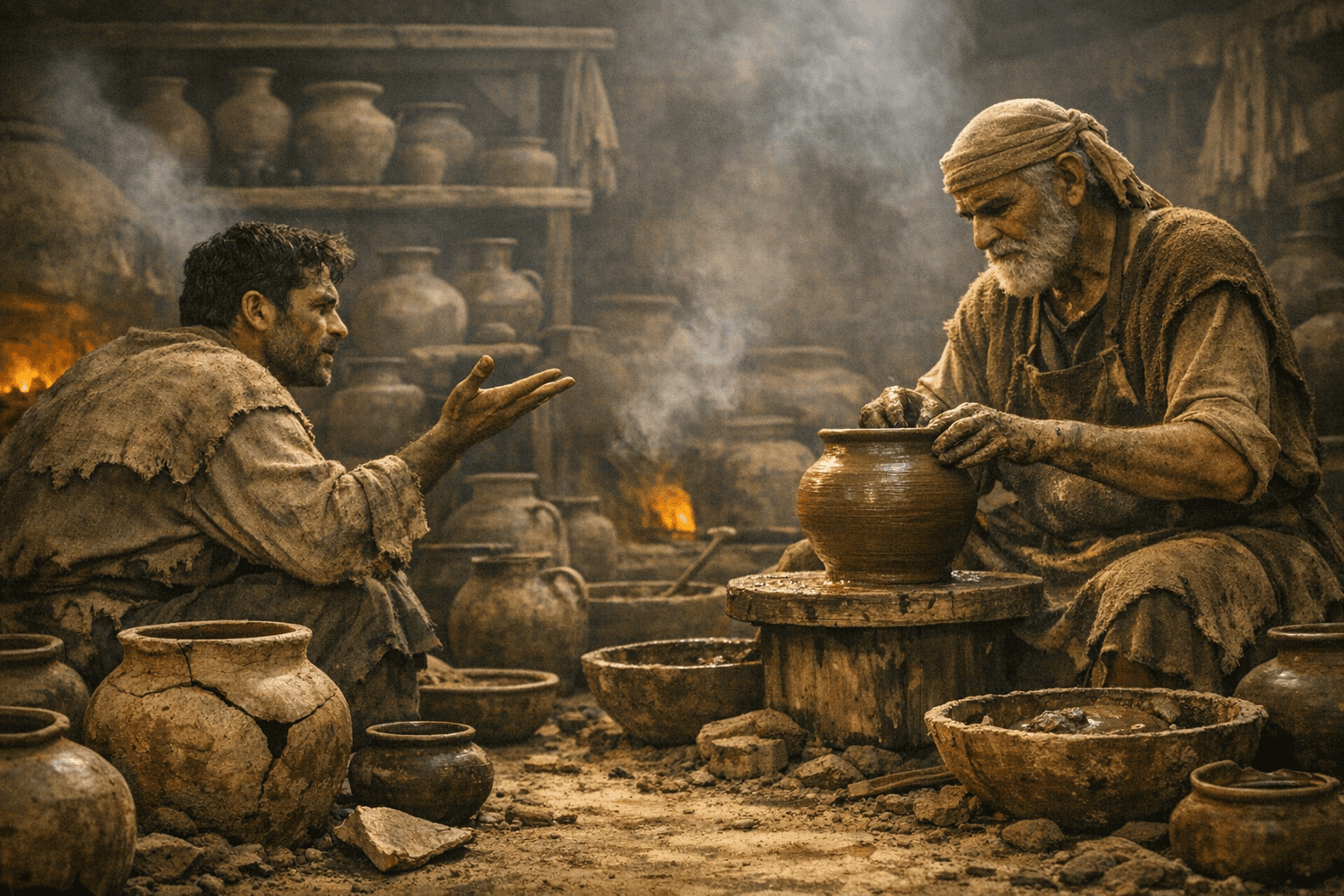
Does the clay question the potter’s hands?
Israel’s complaint against God’s choice of Cyrus was not confusion — it was contention. Isaiah 45:9 draws the line between honest lament and creature litigation and summons the clay back to the wheel.
Questioning God’s Divine Prerogative
“Woe to him who strives with him who formed him, a pot among earthen pots! Does the clay say to him who forms it, ‘What are you making?’ or ‘Your work has no handles’?”
—Isaiah 45:9, ESV
The announcement had come without warning, and it bore a name that would have struck Isaiah’s original hearers as theologically unintelligible: Cyrus. A Persian king. A pagan ruler. A man who had not called on the God of Abraham, Isaac, and Jacob—and yet one whom that same God had called by name before his birth, anointed as a shepherd, and commissioned to authorize the return of exiled Israel to her land (Isaiah 44:28; 45:1–4). Nothing in Israel’s liturgy offered a category for this. Nothing in their covenant history had suggested that God’s faithfulness would arrive wearing the face of an uncircumcised conqueror from the east. The future they were being handed looked nothing like the future they had expected. And into the silence of that bewilderment—into the space where trust had not yet followed understanding—the complaint arose. Why this way? Why him? Why like that? Why, God?
Isaiah 45:9 is God’s answer. It is sharper than we might hope, and more merciful than we might expect.
When Confusion Becomes Contention
The question “Why, God?” is not always what it sounds like. Scripture is full of saints who cried out in grief, who pressed hard into the darkness without receiving an answer, who draped their laments across the altar and refused to let go. God does not silence that kind of praying. But Isaiah 45:9 is addressing something other than grief. The people of God had moved past wondering and into challenging, past anguish and into accusation, past honest prayer and into something the prophets recognized as a fundamentally different posture: striving. And the word God selects to describe what they are doing carries enormous theological freight. It is not the vocabulary of confusion. It is the vocabulary of a courtroom. So what is God correcting here? What truth is buried in the terms Isaiah uses? And how does the canonical witness—from the potter’s house in Jeremiah to the sheep of Psalm 100 to the whirlwind speeches of Job to the doxology of Romans 8—illuminate what God intends Israel to find when she presses into His answer? Words have meaning. The language of Isaiah 45 is not decorative. Every term is load-bearing.
The Courtroom Word
The oracle opens with an arrest. The single syllable that precedes everything else is the Hebrew term for “woe”—hôy (הוֹי)—a vocative cry deployed throughout the prophetic corpus to signal a declaration of grief, a warning of coming consequence, or a word of urgent correction (Isaiah 5:8, 18, 20–22; Jeremiah 22:13; Amos 5:18). The hôy is not a judicial sentence. It is the cry of a father addressing a child who is about to walk off a cliff—both urgent and grieved, both firm and aimed at rescue rather than punishment. Isaiah has already directed this word against those who call evil good and good evil, who trust in the weapons of Egypt rather than in the LORD of hosts. When it arrives in chapter 45, it falls not on Israel’s enemies, not on the nations, but on the covenant people themselves.
What follows explains why. The word God uses to describe Israel’s posture is the Hebrew term for “strives”—rîb (רִיב)—a term that does not merely mean “quarrel” or “grumble.” It is legal language. Courtroom language. Rîb describes the act of bringing a formal case against someone, of summoning an adversary before a tribunal and demanding an accounting. Micah 6:2 uses it precisely this way when the mountains are called as witnesses: “The LORD has an indictment against his people, and he will contend with Israel.” Hosea 4:1 opens the same way: “The LORD has a controversy with the inhabitants of the land.” When rîb moves in the direction of Isaiah 45:9—when the creature uses it against the Creator—it is not describing a moment of grief-stricken protest. It is describing a structural reversal: the clay has issued a summons to the potter.
This distinction is not incidental. Lament and litigation are not the same thing. The Psalter is an entire library of anguished prayer, and God is never offended by the soul that throws itself onto Him in darkness. Habakkuk opened his prophecy with “O LORD, how long shall I cry for help, and you will not hear?” (Habakkuk 1:2), and God answered him. The cry of dereliction from the cross itself reaches back into Psalm 22: “My God, my God, why have you forsaken me?” (Matthew 27:46). There is no depth of anguish that places a person outside the reach of honest prayer.
Job stands at the outer boundary of that territory. He pressed harder than almost any figure in Scripture—demanding an audience, refusing the false comfort of his friends, insisting that God show Himself and answer the charges (Job 23:3–5). And God honored the conversation. But Job’s pressing, at its furthest reach, crossed a line. “Shall a faultfinder contend with the Almighty?” God asks from the whirlwind. “He who argues with God, let him answer it” (Job 40:2). The word translated “contend” carries the same courtroom weight as rîb—the creature positioning itself as the aggrieved plaintiff and the Creator as the defendant who owes a reckoning. God’s response is not a systematic reply to Job’s questions. It is an interrogation that reverses the direction of the courtroom entirely: “Where were you when I laid the foundation of the earth? Tell me, if you have understanding” (Job 38:4). More than sixty rhetorical questions follow, each one compressing the distance between the creature’s presumed vantage point and the Creator’s actual one. The clay’s second question from Isaiah 45:9—”Your work has no handles”—finds its most personal counterpart in Job 40:8: “Will you even put me in the wrong? Will you condemn me that you may be in the right?” Different words, identical posture—the creature indicting the Creator’s competence rather than trusting His purposes. Job, of all people, came closest to legitimate contention. And even he was met with the whirlwind.
Rîb is therefore something categorically different from grief, from honest confusion, from anguished petition. It does not merely grieve—it accuses. It does not merely ask—it indicts. What it does, finally, is not struggle toward God at all but haul Him before a forum of its own making and demand that He answer for Himself. And that posture, God says, must stop.
The Potter’s Hands
To the striving creature, God does not respond with a systematic argument. He responds with a picture. And the word that anchors the picture—”formed”—is not chosen casually. The Hebrew verb yāṣar (יָצַר) is the potter’s word, the same verb that appears in Genesis 2:7 when the LORD God forms the man from the dust of the ground. It is not a word of creation at a distance. It is the word of deliberate, skilled, purposeful craftsmanship—hands in clay, pressure applied with intention, a shape being drawn from resistant material by a maker who knows what the finished vessel is meant to hold. When God says He has formed Israel, He is not merely asserting prior ownership. He is declaring active, present, ongoing engagement with the thing He has made.
Jeremiah learned this at the potter’s house. He stood at the wheel and watched the potter rework a spoiled vessel into another form, “as it seemed good to the potter to do” (Jeremiah 18:4). And then the word came: “O house of Israel, can I not do with you as this potter has done?… Behold, like the clay in the potter’s hand, so are you in my hand, O house of Israel” (Jeremiah 18:5–6). The right of the potter over the clay is not the right of indifference. It is the prerogative of the one whose hands are in the material—who has committed to the work, who bears the cost of the shaping, who holds both the pressure and the purpose simultaneously. To strive against the potter is not merely ingratitude. It is a confusion about the very nature of the relationship: the conviction that the clay has a perspective on the process that the potter has somehow missed.
Two Questions and What They Betray
Isaiah’s oracle is precise about the form Israel’s striving takes. The clay asks two things. First, a question about process: “What are you making?” Second, a verdict about quality: “Your work has no handles.” One questions God’s plan; the other questions God’s competence. The first says, I do not understand this. The second says, this is wrong. Together, they describe the full arc of human objection to divine sovereignty—from confusion to accusation, from disorientation to indictment.
Both questions remain alive in every generation. We ask the first when circumstances feel purposeless—when suffering persists without resolution, when God’s movements appear to have bypassed the very people most committed to Him. We ask the second when circumstances feel defective—when what God has made of our lives looks nothing like what we had hoped, when the vessel on the wheel bears no resemblance to the form we imagined. But clay cannot read the potter’s blueprint. Clay cannot assess the kiln from inside the firing. Clay cannot evaluate the proportions of the finished piece from the perspective of raw material still being pressed. Isaiah 64:8 captures what Israel was being called to receive: “But now, O LORD, you are our Father; we are the clay, and you are our potter; we are all the work of your hand.” Here, the same image that had functioned as correction in chapter 45 becomes supplication in chapter 64—Israel has learned enough from the earlier rebuke to cast herself upon the potter rather than interrogate him. The movement from striving to surrender, from accusation to adoration, is exactly the movement Isaiah intends to produce.
Psalm 100:3 speaks the same truth in declarative register: “Know that the LORD, he is God! It is he who made us, and we are his; we are his people, and the sheep of his pasture.” The grammar is imperative. This is not an invitation to consider a possibility. It is a command to orient reason, prayer, and life around a settled reality: He made us. We are His. The sheep do not direct the shepherd. The sheep are known, called, led, and kept by One whose knowledge of the path exceeds their own entirely. And the same shepherd who leads His flock through the valley of the shadow of death (Psalm 23:4) is the same God who raises up Cyrus to accomplish what no shepherd of Israel would ever have devised. The sheep’s job is not to evaluate the route. The sheep’s job is to follow the voice.
The Answer That Exceeds the Question
What is remarkable about Isaiah 45 is that God does not simply silence the objection. He does not reassert His authority and dismiss the conversation. He speaks. And what He says amounts to three interlocking declarations about His own character, each of which functions as a genuine response to the “Why?” that underlies the striving.
He anchors everything, first, in His identity: “I am the LORD, and there is no other” (Isaiah 45:5). This is not a bare assertion of power. It is a declaration that His actions are coherent with who He is—that there is no version of this God who acts without purpose, without covenant faithfulness, without love for His own. When He does something unexpected through unexpected means, the question is not Has He abandoned His character? but What does His character require here? The LORD who has no other beside Him is the same LORD who called Abraham, who delivered Israel from Egypt, and who swore to David an everlasting throne. His raising of Cyrus does not stand apart from all of that. It is of a piece with all of that.
He anchors His action, second, in covenant purpose: “For the sake of my servant Jacob, and Israel my chosen” (Isaiah 45:4). Cyrus is not God’s goal; Cyrus is the instrument of God’s goal for His people. The unexpected means serve the entirely expected end: the preservation, restoration, and continuation of the covenant community. What Israel experiences as a threat—a foreign king wielded by their God—is in reality a demonstration of comprehensive sovereignty, a sovereignty willing to bend the kingdoms of the earth to accomplish what He has promised.
He anchors His plan, third, in a scope Israel cannot yet see: “Turn to me and be saved, all the ends of the earth; for I am God, and there is no other” (Isaiah 45:22). This is not a message about Israel’s return from Babylon. This is a message about the redemption of nations. Isaiah 64:4 stands as testimony to every generation that has waited on God in bewilderment: “From of old no one has heard or perceived by the ear, no eye has seen a God besides you, who acts for those who wait for him.” What no eye has seen is not the absence of a plan. It is the excess of a plan—one larger, more durable, and more merciful than any arrangement the waiting creature could have proposed. The potter is not shaping one vessel. He is shaping a household.
Paul arrives at the same ground by way of Romans 9, pressing the same potter-and-clay image into the hardest questions of divine sovereignty: “Will what is molded say to its molder, ‘Why have you made me like this?’ Has the potter no right over the clay?” (Romans 9:20–21). The rîb of Isaiah becomes Paul’s rhetorical question, and the answer is identical. The potter’s authority over the clay is not tyranny. It is the inherent prerogative of the One who forms, purposes, and sustains. And it is a prerogative exercised by a God whose comprehensive purposes, as Romans 8 makes clear, are entirely and irreversibly disposed toward those who belong to Him: “What then shall we say to these things? If God is for us, who can be against us?” (Romans 8:31). The “these things” to which Paul points are the sufferings, the groanings, the not-yet of a creation still waiting for full redemption—exactly the circumstances that generated the striving of Isaiah 45. And Paul’s answer is not an explanation of the circumstances. It is a declaration about the God who governs them. If the potter is for us, then the shaping, the pressure, the kiln—all of it serves purposes that cannot ultimately harm what He has claimed as His own.
The Same Lump, Different Purposes
Romans 9:21 does not stop at the potter’s authority. It presses into the most unsettling dimension of the image: “Has the potter no right over the clay, to make out of the same lump one vessel for honorable use and another for dishonorable use?” The Greek word Paul selects for “honorable”—timē (τιμή)—carries the full weight of worth, dignity, and appointed purpose. Its counterpart, translated “dishonorable”—atimia (ἀτιμία)—denotes not merely lowliness but the absence of that appointed standing. What Paul is pressing into is not a crude hierarchy of worthiness but something more precise and more unsettling: the potter works from the same raw material and produces vessels of entirely different destinies, and the differentiation belongs entirely to the potter’s sovereign will.
This is not a comfortable doctrine. It was not meant to be. Paul anticipated the objection immediately: “You will say to me then, ‘Why does he still find fault? For who can resist his will?’” (Romans 9:19). That is the rîb of Isaiah 45 restated in the idiom of Roman rhetoric—the creature calling the Creator to account, demanding that sovereignty be made to answer for itself on terms the creature has set. Paul’s response does not soften the doctrine. It anchors it further: “But who are you, O man, to answer back to God?” (Romans 9:20). The potter’s authority over the clay is not a theological abstraction to be debated at a comfortable remove. It is the lived reality of a creation that did not make itself, does not sustain itself, and cannot appoint its own purpose.
And yet the vessel language does not remain only in the register of sovereignty. It moves, in Paul’s pastoral writing, into something the clay can actually do with. In 2 Timothy 2:20–21, the same image returns, now aimed not at silencing objection but at orienting effort: “Now in a great house there are not only vessels of gold and silver but also of wood and clay, some for honorable use, some for dishonorable. Therefore, if anyone cleanses himself from what is dishonorable, he will be a vessel for honorable use, set apart as holy, useful to the master of the house, ready for every good work.” The great house is not a theoretical construct—it is the household of God, the church, the covenant community within which various vessels serve various purposes under the governance of the same Master. And here, remarkably, the passivity of the clay is met by a call to active cooperation: cleanse yourself. Not form yourself—the potter has not surrendered His wheel. But orient yourself toward the purpose the potter has appointed. Surrender to the shaping rather than striving against it.
This is the pastoral resolution that the striving of Isaiah 45:9 always required. The question was never whether the clay could negotiate its own purpose. The question was whether the clay would yield to the hands that hold it—hands that know the difference between what the vessel is now and what it is being made to become. Israel striving against the means by which God was accomplishing her restoration was clay resisting the pressure that would produce the form. The correction is not resignation. It is reorientation. The vessel for honorable use is not the one that demanded its own design—it is the one that submitted to the potter’s, and found in that submission exactly the purpose for which it was made.
Hands That Will Not Let Go
Isaiah 45:9 remains a summons as much as it is a word of correction. Every generation that strives with its Maker—and every generation does—is being called to the same reckoning: Who is doing the forming? Who holds the clay? Who has seen the end from the beginning and called a pagan king by name before he was born to accomplish purposes that span the nations?
“Woe to him who strives with him who formed him.” The woe is not the whole of what God says. But it is where He begins—with an arrest, a call to attention, a word of prophetic correction aimed not at condemnation but at reorientation. The One who says hôy over Israel’s striving is the same One who says, “I am the LORD, and there is no other” (Isaiah 45:5). The One who silences the clay’s two questions is the same One who silenced Job’s from the whirlwind—not with an answer to every charge, but with the weight of His own presence and the breadth of His own purposes. The God of Isaiah 45 is not hiding behind His authority. He is offering Himself as the answer—His character, His covenant, His comprehensive and unwavering purpose—to a people who wanted a different God, or at least a more predictable one.
The potter’s answer to the clay is not a blueprint. It is a Person. He is the LORD, who formed us, who forms us still, and whose hands—pressed into us from the beginning—will complete what they began.
Editor’s Note: Every believer will come, more than once, to the place where the only word that forms is “why.” This is not necessarily insolence. It is the cry of the vessel that cannot yet see what the potter’s hands are making.
The article draws a careful line between lament and litigation — between the anguished prayer God honours and the adversarial posture He corrects. That line is worth holding. But the correction itself comes from a Father who has not stepped back from the wheel.
“For my thoughts are not your thoughts, neither are your ways my ways, declares the LORD” (Isaiah 55:8). It is a word worth learning to say early, before confusion hardens into accusation.
Ask. But ask ready to be redirected — not condemned, redirected — toward a perspective larger than the one the vessel can see from inside the firing.