
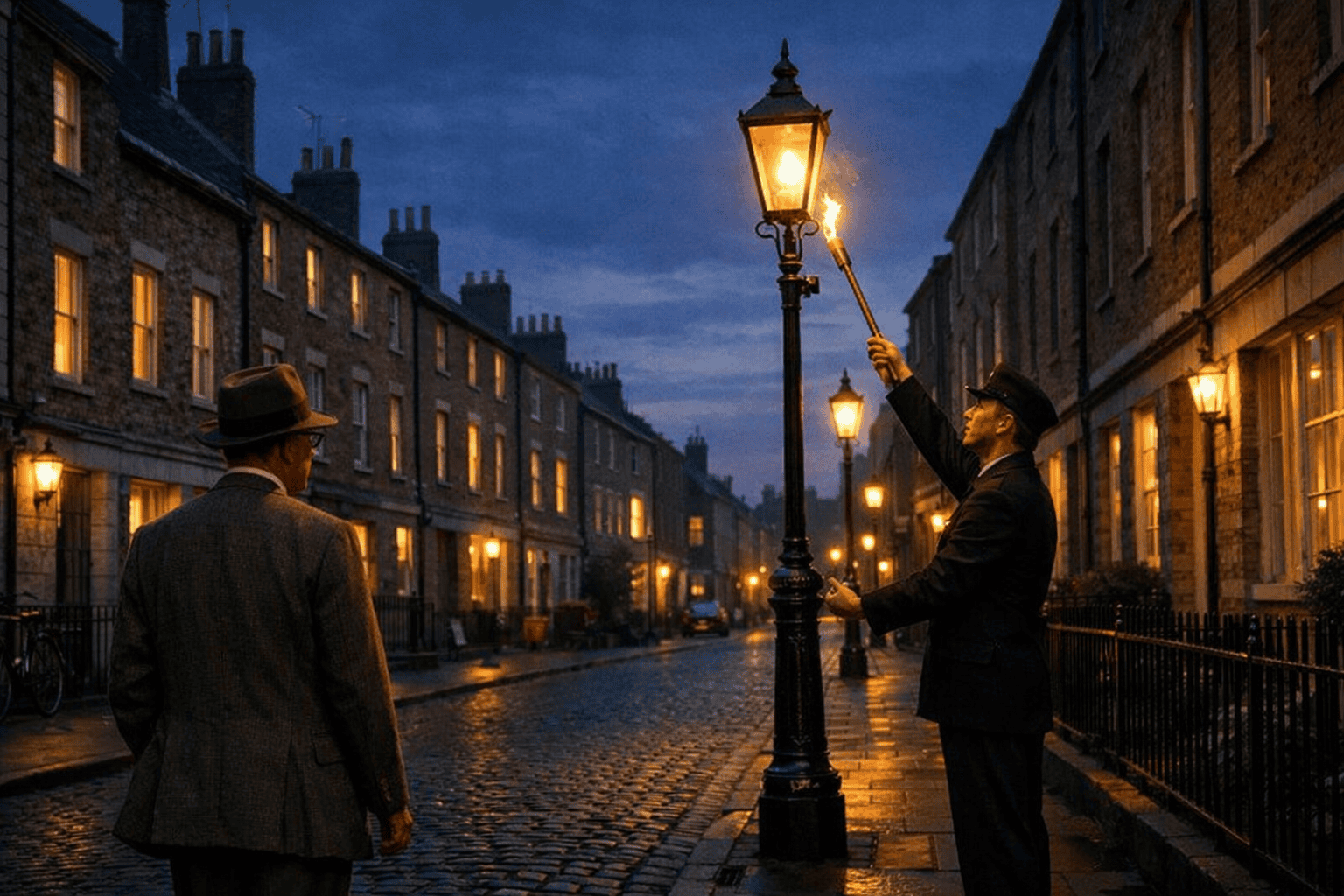
The Son is gone — and the light is not.
“Night is coming, when no one can work” is not a sermon about staying busy before you die. Some have cast it that way for years — but the verse warns of a darkness that fell on the whole world, and the dawn that broke only because it did.
Why “Night Is Coming” Was Never About Wasted Time
“We must work the works of him who sent me while it is day; night is coming, when no one can work. As long as I am in the world, I am the light of the world.”
—John 9:4–5, ESV
The words fall between a question and a miracle. A man born blind sits where he has always sat, and the disciples, seeing him, ask the question their world had trained them to ask: whose sin produced this ruin, his own or his parents’ (John 9:2). Jesus refuses the premise. The blindness is not a ledger of guilt but a stage on which the works of God will be displayed (John 9:3). And then, before He bends to the ground and makes clay and gives a man eyes that have never seen, He says something that reaches far past the moment. He speaks of day and of night, of working and of a coming hour when work will end. He binds His healing of one blind beggar to a clock that is running down. The light is shining now. It will not always shine here.
This is not a saying about the brevity of human life, though it has often been pressed into that service. It is a saying about Him. The day is the span of His presence in the world; the night is the hour of His withdrawal through the cross. And the strange, sober claim at its center — that a time is coming “when no one can work” — is not a lament over mortality in general. It is a statement about a particular work that only the present Light could do, and about the falling of a darkness in which that particular work would, for a time, become impossible.
The Clock Behind the Clay
The tension sits in three words: night is coming. Jesus heals as one who knows the daylight is finite. He does not heal at leisure. He heals against a horizon. And He draws His disciples into the urgency with a pronoun that the best manuscripts preserve against the easier reading — not “I must work” but “we must work the works of him who sent me.” The labor is His, sent and commissioned by the Father, yet He gathers His own into the daylight with Him. The hour is short for all who stand in the light while it is here.
Why does this matter for doctrine, and not merely for diligence? Because the saying locates a real limit inside redemptive history. There is a work tied to the Light’s bodily presence in the world, a revelation given by nearness, by voice, by touch, by the pressing of clay onto sightless eyes — and that mode of working has an end. To read “night is coming, when no one can work” as a generic call to industry before death is to miss what the verse is actually pressing. The Berean question is sharper than that. What work ends when the night falls? Why can no one do it once the Light has withdrawn? And if a work ends, what does the dawn that follows make possible that the daylight never could? Scripture answers these in order, and the answers run from creation to Pentecost and out to the ends of the age.
The Necessity Laid on the Light
The verb beneath “we must” carries weight the English only partly shows. The word is must — deî (δεῖ) — the language of divine necessity, of what is bound and ordained rather than merely advisable. John reaches for this word at the hinges of his Gospel: the Son of Man must be lifted up (John 3:14); the true worshipers must worship in spirit and truth (John 4:24). It is not the necessity of obligation imposed from outside but the necessity of a purpose set in motion before the foundation of the world. When Jesus says “we must work,” He is not urging effort. He is naming a divine appointment whose window is open and whose closing is fixed.
And the works themselves are erga (ἔργα) — deeds, but in John never bare deeds. The works of Jesus are the works of the Father made visible (John 5:36; 10:37–38). They testify. They reveal. The healing of the blind man is not a kindness detached from doctrine; it is a sign, a thing done so that what is true might be seen. To work the works of God, in this Gospel, is to make the invisible Father legible in the flesh of the Son. This is why the labor cannot simply be transferred to anyone at any time. It belongs to the daylight of the incarnation, to the years when the Word made flesh walked among His own and they beheld His glory (John 1:14).
The labor is described with a further verb worth weighing. “We must work” renders ergazomai (ἐργάζομαι), to labor at a task, to be occupied with a commissioned work rather than to busy oneself generally. It is the language of a workman with an assignment and a deadline, not a man filling his hours. The daylight is the duration of the assignment. When the assignment’s appointed hour arrives, the working stops — not because the Worker fails, but because the work He came to do in this mode reaches its terminus at the cross.
The Hour Called Night
Jesus names the coming darkness elsewhere, and the naming removes any doubt about what He means. On the night of the betrayal, when Judas takes the morsel and goes out, John records four words that toll like a bell: “And it was night” (John 13:30). The clock has run down. In the garden, Jesus tells the men who come for Him with torches and clubs that this is their appointed hour, “and the power of darkness” (Luke 22:53). The night that was coming in John 9 has arrived. The Light of the world is being seized, and the world is choosing the dark. The word for light here — phōs (φῶς) — is simply our own word for light, carrying no freight the English does not already bear; the weight of this passage lies not in the term but in its position, the light that is among men and the night that takes it from among them.
Earlier still, He had warned the crowds in the same idiom: “The light is among you for a little while longer. Walk while you have the light, lest darkness overtake you” (John 12:35). The little while is the daylight. The overtaking darkness is the night. And in that same passage He presses the urgency to its point: “While you have the light, believe in the light, that you may become sons of light” (John 12:36). The withdrawal of the Light is not a metaphor for general gloom. It is the cross — the hour when the embodied revelation that walked the roads of Galilee would be lifted up, would die, would be laid in a tomb, and would no longer be present in the world in the way He had been present.
This is the answer to the first half of the Berean question. The night is the cross and the withdrawal it accomplishes. The Light that had been among them, visible and local and able to be followed on foot, would no longer be among them in that mode. And the world’s verdict on that Light was not neutral. John had already declared it: “the light has come into the world, and people loved the darkness rather than the light because their works were evil” (John 3:19). The world here — kosmos (κόσμος) — is more than the globe or its population; in John it names the ordered human realm in its settled estrangement from God, the system that “did not know him” though it was made through him (John 1:10). To be the light of the kosmos is therefore to shine into a domain organized against the One who shines. The night is not merely Jesus’ absence. It is the world’s preference, ratified at Golgotha.
What No One Could Do
Now the harder half. Why “when no one can work”? The phrase is stark. Not when I can no longer work, but when no one can. The saying seems, at first, to forbid even the disciples from laboring in the dark. And in a precise sense, for a precise span, it did.
Consider the men who had been gathered into the daylight with Him. When the night fell, their working did stop. Their understanding collapsed; they had not grasped that He must rise (John 20:9). Their courage failed; the boldest denied Him three times before the cock crew (John 18:27). They scattered, as He said they would (John 16:32). The mission froze. Between the cross and Pentecost the record shows no proclamation to the nations, no signs done in His name — the men wait rather than work. The men who would later turn the world upside down sat behind locked doors “for fear” (John 20:19). The night had come, and in it, no one could work.
But the saying reaches deeper than the disciples’ paralysis. There was a particular work that belonged to the Light’s bodily presence and could not be done once that presence was withdrawn — the work of revelation by nearness, the giving of sight by the hand of God in flesh, the making of the Father visible in a face that could be looked upon. That work had its day. The clay pressed onto blind eyes was the work of the daylight; it could not be repeated once the daylight was gone, because the One whose presence made it revelation had entered the night. To say “no one can work” is to confess that this mode of divine working was never the disciples’ to carry. It was the Light’s own, bound to His days in the world, and it ended when those days ended.
There is mercy hidden in the starkness. The disciples could not work in the night because they were never meant to work in the night as they were. They needed something they did not yet have. The daylight work was finished; the next work waited on a different coming.
The Coming That the Night Required
Here the saying opens onto the whole arc of redemptive history, and the logic runs deeper than the limit first suggested. The Light had to withdraw so that a greater nearness could be given. Jesus says it plainly in the upper room: “it is to your advantage that I go away, for if I do not go away, the Helper will not come to you. But if I go, I will send him to you” (John 16:7). The going-away is the night. And the night is not the end of the working but the precondition of a new working — the coming of the Spirit who would not merely walk beside them but dwell within them.
John had already marked the boundary. Explaining a saying about rivers of living water, he notes: “as yet the Spirit had not been given, because Jesus was not yet glorified” (John 7:39). The glorification is the cross and the exaltation that follows. Before that hour, the Spirit’s indwelling ministry had not begun. The daylight of the incarnation had to close before this new dawn could break. Jesus names the difference precisely when He promises the Helper: the world cannot receive Him, “but you know him, for he dwells with you and will be in you” (John 14:17). With you belongs to the daylight; in you belongs to the dawn that the night made way for.
So the night that ended the disciples’ working was the very thing their future working required. They could not labor between cross and Pentecost because the equipping had not yet come. When it came, it came not as a Teacher walking ahead of them on the road but as a Presence within them, and the working that resumed was of a different and wider kind. The mode of revelation shifted — from light shining among men to light shining within men. Paul gathers the whole movement into a single sentence: “For God, who said, ‘Let light shine out of darkness,’ has shone in our hearts to give the light of the knowledge of the glory of God in the face of Jesus Christ” (2 Corinthians 4:6). The light that once stood before their eyes now shines from within their hearts.
The Works Refracted, Not Replaced
What then of the works? If the Light’s bodily working ended at the cross, and a new working began at Pentecost, are they the same works or different ones? The answer holds the paradox together without dissolving it. The works that follow are not the daylight works repeated; they are those works refracted through the church by the Spirit. The signs Jesus did testified to His own identity as the Light (John 10:25). The signs the apostles did testified to the message about Him. Hebrews marks the shift: the great salvation “was declared at first by the Lord, and it was attested to us by those who heard, while God also bore witness by signs and wonders and various miracles and by gifts of the Holy Spirit” (Hebrews 2:3–4). The miracles did not cease; their office changed. They moved from revealing the Light in person to confirming the proclamation of the Light now ascended.
The apostles are lamps, not the Sun. Jesus had said it of His followers: “You are the light of the world” (Matthew 5:14) — but the light they bear is borrowed, a derivative glow meant to be seen so that men “give glory to your Father who is in heaven” (Matthew 5:16). The believer shines, but with reflected radiance. The night did not extinguish the Light; it relocated its shining. The Light withdrew from among us and took up residence within us, and the works of God went on — no longer by the hand of the incarnate Word pressing clay onto blind eyes, but by the Spirit pressing the knowledge of Christ into darkened hearts and sending out a people to carry that knowledge to the ends of the earth.
One Light Across the Canon
Step back and the whole of Scripture tells a single story of light, and John 9 sits at its hinge. In the beginning God speaks light into being before sun or moon exists, declaring that the source of light is not a luminary but Himself (Genesis 1:3). The Psalms make the confession personal: “The LORD is my light and my salvation” (Psalm 27:1); “in your light do we see light” (Psalm 36:9). The prophets promise a dawn for those who sit in shadow: “The people who walked in darkness have seen a great light” (Isaiah 9:2), and the Servant is appointed “as a light for the nations” (Isaiah 49:6). Then the Word becomes flesh, and “the true light, which gives light to everyone, was coming into the world” (John 1:9). The promised dawn had a face.
And that face spoke of night. The Light who had been promised across the ages announced, in the hearing of a blind man about to receive his sight, that His daylight was finite and a darkness was near. The cross came. The night fell. The working of the incarnate Light reached its appointed end. And out of that night rose a dawn the prophets had not fully seen — not the Light returning to walk among men, but the Light descending to dwell within them, until the canon closes on a city that needs no sun, “for the glory of God gives it light, and its lamp is the Lamb” (Revelation 21:23). The Light that began creation will fill the new creation. Between the first light and the last stands the hinge: the day the Light worked, the night it withdrew, and the dawn in which it took up residence in the hearts of His people.
The Lamb Is Its Lamp
Return to the blind man and the clay. Jesus heals him as the daylight is closing, and the healing is a parable of everything the saying contains. A man who has never seen receives sight from the hand of the Light, in the hour when the Light is still in the world to give it. “As long as I am in the world, I am the light of the world.” The qualification is the whole point. As long as — for the daylight has a measure, and the night was coming.
It came. The Light was lifted up and withdrawn, and for a span no one could work, because the work of the present Light was His alone and it was finished. But the withdrawal was not defeat; it was the door. The Light went away so that a nearer Light might come, no longer shining before the eyes of His people but within their hearts, until the day breaks and the shadows flee and the city descends where the Lamb Himself is the lamp. The works of God are still being worked. The daylight of the incarnation closed, but the dawn it purchased has not yet ended. We labor still in the light He left within us, waiting for the unsetting morning.