
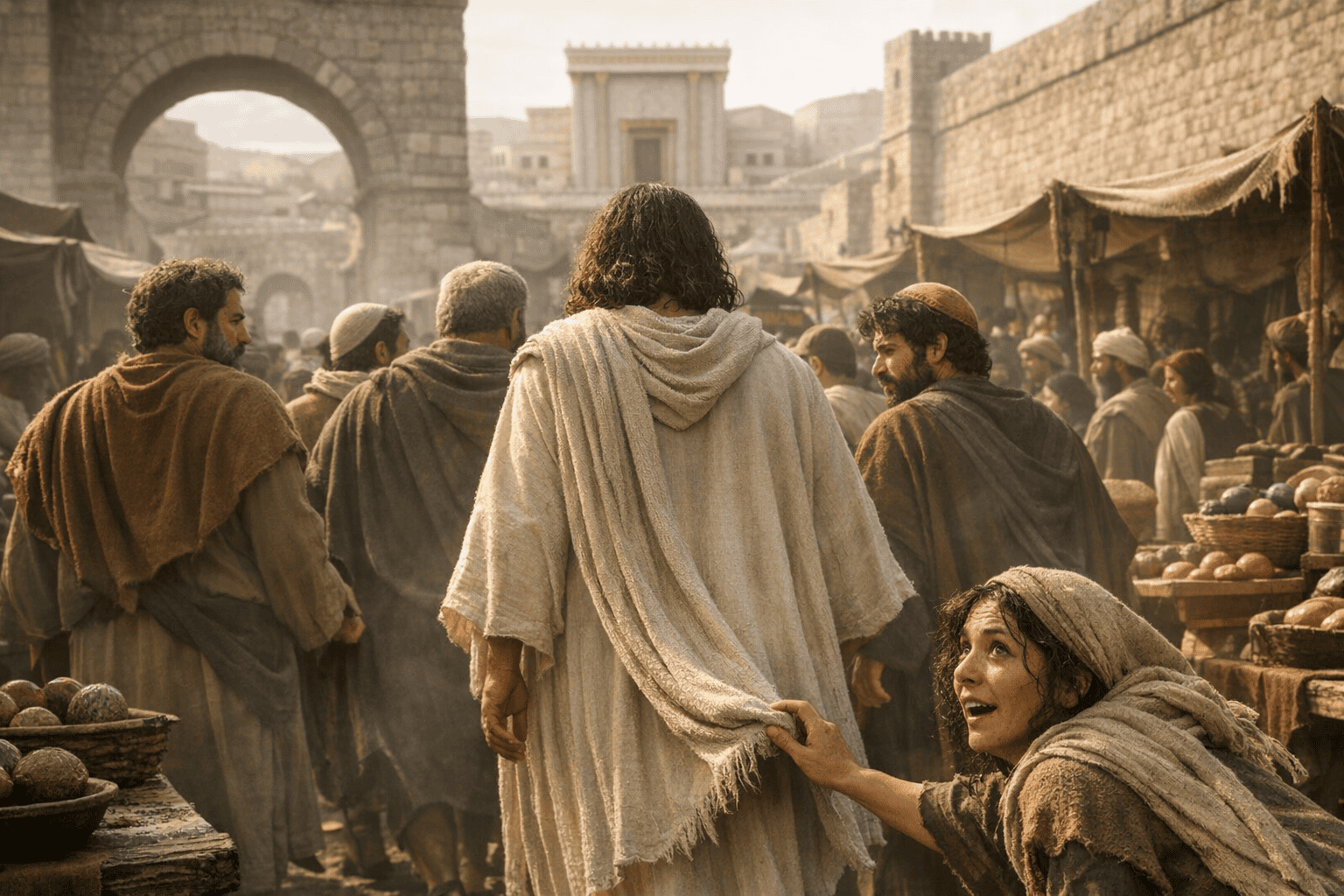
What kind of person heals by simply being present?
Rebuking, Healing, Exorcising, and Discerning — The Gospels present Jesus’ miracles not as demonstrations of borrowed authority but as revelations of His divine nature — power that flows from who He is, not merely from what He does.
On the Divine Nature Revealed in the Works of Christ
“And all the crowd sought to touch him, for power came out from him and healed them all.”
—Luke 6:19, ESV
“And all the crowd sought to touch him, for power came out from him and healed them all.” (Luke 6:19, ESV)
The twelve apostles have just been named—Simon, Andrew, James, John, Philip, and the rest—called out by name from a full night of prayer on a mountain (Luke 6:12–16). Jesus descends with them to a level place. The crowd is already waiting: from Judea and Jerusalem, from the coast of Tyre and Sidon, they have come not primarily for a lecture but for a touch. What Luke records next is not a single miracle with a beginning and an end. It is a condition—a steady, ongoing atmosphere of restoration flowing from one Person. Power came out from him. Not at intervals. Not upon ceremony. Not following a formula or a petition. It came out from him the way heat comes out from fire—because that is what fire does, and because this is who He is. Before He opens His mouth to teach a word of the Sermon on the Plain, the crowd learns something more fundamental than any command He will give: they learn what kind of Person is standing in front of them.
Power That Belongs to Being
The question the Gospels keep pressing is not whether Jesus heals. That much was evident enough to generate the crowds who followed Him through Galilee, across the lake, and up into the hills. The deeper question—the one that the miracles themselves force upon every observer—is what His healing reveals about Him. The miracles are not performances inserted to validate a message. They are not credentials displayed to open an audience. They are the message; or rather, they are windows into the Person who delivers it. Every fever rebuked, every paralytic restored, every storm silenced, every demon evicted is an act that belongs to a particular category of authority—not borrowed, not delegated, not granted for the occasion. The Gospels present Jesus’ power as essential to His identity, flowing outward from His nature as inevitably as light flows from a lamp. To observe what He does is to be pressed toward a verdict about who He is, and that verdict admits of only one conclusion.
A Healing That Asks Nothing
The woman had spent twelve years in a condition that left her ceremonially excluded, financially ruined, and medically abandoned (Mark 5:25–26; Luke 8:43). Luke notes that she had spent all she had on physicians and could not be healed by any. She does not request an audience with Jesus. She does not announce her intention. She presses through the crowd, reaches out, and touches the fringe of His garment—and immediately her discharge of blood ceases (Luke 8:44).
Jesus does not perform a technique. He does not speak a word of healing. He does not reach toward her. He simply perceives—as Luke records it—that power had gone out from him (Luke 8:46). The word Luke uses for power is the Greek term dunamis (δύναμις), a word carrying the sense of inherent capacity, the energizing force native to what something fundamentally is. This is not authority exercised from a position, as an official might exercise it over those beneath him. This is capacity that flows from being. When the woman touches Him, she does not access a reservoir He has been given to manage on behalf of another. She makes contact with what He is, and what He is flows toward her faith and heals her.
The disciples are baffled. The crowd is pressing against Him from every direction, and Jesus asks who touched Him—not because He is uncertain, but to draw the woman and the crowd into what has happened (Luke 8:47–48). He draws her out not to embarrass her but to name what has taken place. Her faith reached Him, and what proceeded from Him healed her. His holiness does not contract at the touch of ceremonial uncleanness. It expands. It cleanses. What defiles does not flow from the world into Him; what restores flows from Him into the world. This is the reversal that marks the arrival of the kingdom of God—and it is grounded entirely, not in a method or a ministry, but in the Person at its center.
The Wound beneath the Wound
Four men carry a paralyzed friend to the house where Jesus is teaching, find it impossibly crowded, and proceed to dismantle the roof and lower the man through the opening (Luke 5:17–19). Luke notes that Pharisees and teachers of the law were sitting there, having come from every village of Galilee and Judea and from Jerusalem—gathered, one suspects, to evaluate. What they are about to witness will require no further evaluation.
Jesus looks at the man and says, “Man, your sins are forgiven you” (Luke 5:20, ESV). The scribes and Pharisees understand precisely what this means and precisely why it presents a problem. “Who is this who speaks blasphemies? Who can forgive sins but God alone?” (Luke 5:21, ESV). Their theology is correct. Forgiveness of sin is a divine prerogative—a right that belongs to God alone and cannot be transferred or borrowed. The God of Israel is the One who pardons iniquity and passes over transgression (Micah 7:18). To declare forgiveness is to exercise an authority—the Greek word is exousia (ἐξουσία), the right and power to act on one’s own grounds—that belongs to God and to no one beneath Him. Jesus does not qualify His statement. He does not appeal to a priestly role or a prophetic commission. He speaks as the One to whom the offense against God belongs, because He is God, the One against whom all sin is ultimately committed (Psalm 51:4).
Then He heals the paralysis—but the healing is secondary to the claim, not prior to it. It is the visible proof of an invisible miracle. “But that you may know that the Son of Man has authority on earth to forgive sins,” He says, and then commands the man to rise, take up his bed, and go home (Luke 5:24, ESV). The legs move. The crowd is seized with astonishment. But what they have witnessed is not a remarkable healer who also said something theologically audacious. They have witnessed someone who treats divine prerogatives as His own—because they are.
The God Who Rebukes
The scene on the Sea of Galilee admits no comfortable distance. Jesus is asleep in the stern on a cushion. A great windstorm rises. The waves fill the boat. The disciples, several of them seasoned fishermen, are terrified enough to wake Him with something that sounds nearly like an accusation: “Teacher, do you not care that we are perishing?” (Mark 4:38, ESV).
Jesus wakes, and He rebukes the wind. The verb Mark uses is epitimaō (ἐπιτιμάω)—to rebuke with authoritative force, the same verb Mark uses when Jesus commands unclean spirits (Mark 1:25; 9:25). He does not pray for the storm to cease. He does not appeal to the Father’s intervention. He speaks to the wind as one who owns it, and says to the sea, “Peace! Be still!” (Mark 4:39, ESV). The wind ceases. There is a great calm.
The disciples ask the question they cannot answer: “Who then is this, that even the wind and the sea obey him?” (Mark 4:41, ESV). The Psalms had always known the answer. It is the Lord who stills the storm and quiets the waves (Psalm 107:29). It is He who commands and it stands firm, who speaks and it is done (Psalm 33:9). That voice—the voice that separated the waters and set the boundaries of the sea at creation—has just spoken from the stern of a fishing boat. This is not prophetic authority, in which a man delivers words given to him by God. This is what may rightly be called Genesis authority: the same spoken command by which light came to be and waters gathered to their appointed places (John 1:3; Col. 1:16). Creation obeys Him because Creation belongs to Him.
What the Demons Already Know
There is a persistent irony running through the Gospel accounts: the demons identify Jesus more accurately and more quickly than the human crowds do. In the synagogue at Capernaum, before Jesus has done anything more than begin to teach, an unclean spirit cries out, “I know who you are—the Holy One of God” (Mark 1:24, ESV). On the far shore of the lake, the demon called Legion, confronted by Jesus before Jesus has spoken a word, falls before Him and begs, “What have you to do with me, Jesus, Son of the Most High God? I adjure you by God, do not torment me” (Mark 5:7, ESV). The demons do not test Him. They do not argue with His authority. They beg.
Jesus uses none of the techniques of ancient exorcism—no incantations, no fumigations, no invocation of higher names, no extended ritual. He commands, and the spirits comply. He does not invoke a higher authority because none exists over Him. The One through whom all things were created, “whether thrones or dominions or rulers or authorities” (Colossians 1:16, ESV), does not petition what He made. The verb in Mark 1:25 is again epitimaō—the same rebuke He will issue to the storm. The register is identical because the authority is identical. He who commands wind and wave commands unclean spirits in precisely the same way, because both exist within His created order and beneath His sovereign rule. When they flee from Him, they flee as subjects flee a king—not as a darkness flees a match, but as a usurper yields to the rightful owner of what he has wrongly occupied.
Luke records that after the deliverance of the Gerasene demoniac, the restored man begs to remain with Jesus (Luke 8:38). Whatever the man had endured—the tombs, the chains, the isolation, the self-destruction—and whatever he had witnessed Jesus do, his response is not confusion or fear but nearness. The restored man reaches toward what the disciples are still working toward: to be near this Person is to be near something categorically unlike anything else in creation.
The Hidden Things
Among the displays of divine power in the Gospels, the least dramatic to observe and the most theologically weighted is Jesus’ knowledge of what cannot be seen. When the scribes and Pharisees begin to question His forgiveness of the paralytic—not aloud, but inwardly—Luke records that Jesus perceived their thoughts and answered them directly (Luke 5:22). John’s account states the principle directly: Jesus “knew all people and needed no one to bear witness about man, for he himself knew what was in man” (John 2:24–25, ESV).
This is not heightened intuition. It is not the practiced discernment of a wise teacher who has learned to read faces and rooms. Jesus reads the interior of persons—motives, objections, fears, questions never voiced—with the same effortless consistency that characterises His healing. He does not strain to know hidden things. He simply knows, the way He simply heals, because knowledge of all things belongs to His nature. The Psalms declare that God knows the thoughts of man (Psalm 94:11), that He searches the heart and tests the mind (Jeremiah 17:10). What the Old Testament attributes to God alone, Jesus exercises without caveat, ceremony, or credential. He does not access this knowledge; He possesses it, because He is the One of whom the Psalms and the prophets spoke.
What the Mountains Are For
Jesus speaks of mountain-moving faith twice in the Synoptic gospels—Matthew, Mark, and Luke, the Gospels that share a common narrative frame—and the statement can be misread as a claim about the power of human confidence (Matthew 17:20; Mark 11:23). But the disciples who hear these words have just watched Jesus heal the demonised boy that they could not. They have seen Him rebuke a storm. They have watched Him speak to a dead girl and have her rise (Luke 8:54–55). The faith He commends is not faith in an abstract possibility. It is faith in a specific Person—the One in whom all power inheres, the One from whom power came out on the plain, the One who treats divine prerogatives as His own.
Mountain-moving faith is not a claim about human potential. It is a claim about divine sufficiency. The invitation to pray with expectation, to bring impossible things before God, is an invitation grounded entirely in the identity of the One being addressed. The mountains move not because faith is powerful in itself but because the One toward whom faith reaches is powerful—and not contingently so, not derivatively so, but essentially so. Faith is only as strong as its object is trustworthy, and the object of Christian faith is the One from whom power came out and healed them all.
The Same Power Still
Luke 6:19 places this moment before the Sermon on the Plain begins—before the Beatitudes, before the commands to love enemies, before the warning about the house built on sand rather than rock. Jesus teaches what He teaches as the One from whom power proceeds. The crowd that pressed toward Him and sought to touch Him and was healed was reaching toward the One who holds authority over sin and sickness, over storm and spirit, over the visible and the invisible alike. That authority did not diminish on the road to Golgotha. It absorbed death from within on the third day and emerged unchanged. And it remains the ground of every prayer offered in His name, every broken life brought to His feet, every confession made in the faith that the One who receives it is the same One who forgave the paralytic—not as an agent of another’s mercy, but as the source of it. The crowd sought to touch Him. They were right to.