
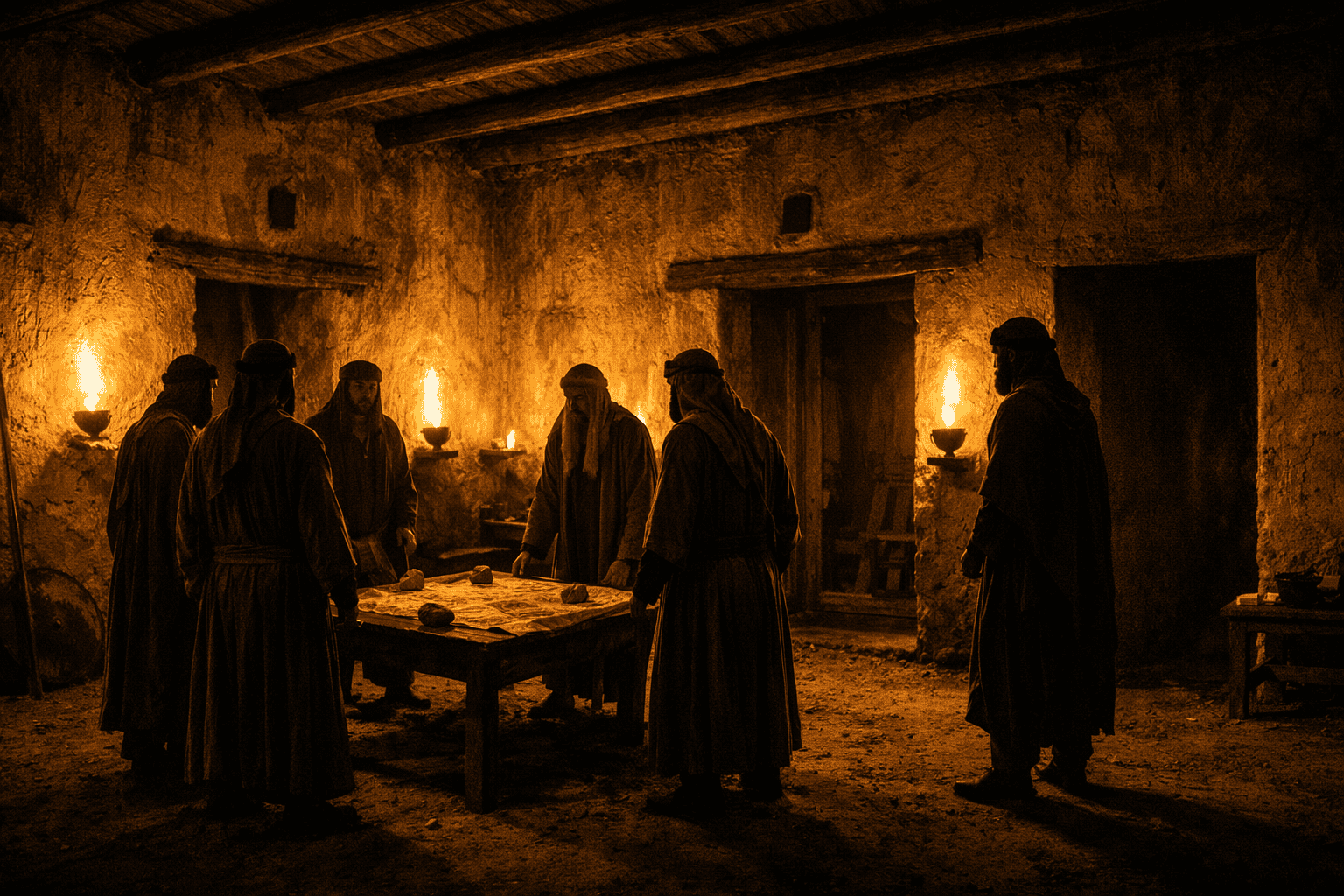
When the wiser counsel loses.
Ahithophel’s advice was sound — the better strategy by every visible measure — and it was overruled. What does it mean that God ordains the defeat of human wisdom while a free man believes he is simply weighing his options?
While He Thought He was Being Shrewd, He Was Being Steered.
“And Absalom and all the men of Israel said, ‘The counsel of Hushai the Archite is better than the counsel of Ahithophel.’ For the LORD had ordained to defeat the good counsel of Ahithophel, so that the LORD might bring harm upon Absalom.”
—2 Samuel 17:14, ESV
The scene is a war council in a captured city. David has fled Jerusalem barefoot and weeping, his throne seized by his own son, and the man whose advice once carried the authority of an oracle has now turned that authority against him. Ahithophel has counseled Absalom to strike immediately, while David is exhausted and exposed, and the counsel is sound. It would have ended the rebellion that night, and it would have ended David with it. Then a second voice speaks, the counsel of Hushai, slower and weaker and wrong, and Absalom takes it. The narrator does not leave the reader to wonder why. He names the cause: the LORD had ordained it. The better counsel was defeated not because it was answered but because it was overruled.
When the Wiser Word Loses
Here is the tension the verse presses upon every reader who takes it seriously. The text does not say Ahithophel’s counsel was bad and Hushai’s was good. It says the opposite. Ahithophel gave good counsel, the better strategy by every visible measure, and it lost — not on the field but in the deliberation, because God had already determined the outcome and was now bringing it to pass through the free choice of a proud young king who believed he was simply weighing his options. Absalom thought he was being shrewd. He was being steered. The question this raises is not whether God can act in history but how He acts: whether His providence is the distant foreknowledge of a spectator who sees the future, or the active governance of a King who ordains it. The Bereans of Acts 17:11 received the word eagerly and then searched the Scriptures to see whether these things were so, and the Scriptures, searched, return a consistent answer about the counsel of men and the purpose of God. This single defeated strategy in a Judean war room is the whole doctrine in miniature, one household’s rebellion enacting what the canon declares from end to end.
The Counsel That Sounded Like God
To feel the weight of 2 Samuel 17:14, one has to feel the weight of the man it brings down. Ahithophel of Giloh was no minor functionary. The narrator tells us that in those days the counsel he gave “was as if one consulted the word of God” (2 Samuel 16:23), esteemed that highly by David and Absalom alike. This is the highest evaluation of human wisdom anywhere in the books of Samuel; his word functioned, in the estimate of kings, like a word from the sanctuary.
The term standing under all of this is counsel — ‘ēṣâ (עֵצָה) — advice, plan, the settled strategy of a mind that has weighed the options and reached a verdict. It is the noun that governs the entire Absalom narrative. David prays against Ahithophel’s ‘ēṣâ; Hushai is sent to defeat Ahithophel’s ‘ēṣâ; Absalom convenes his counselors to hear their ‘ēṣâ. The word gathers the whole drama of the rebellion into a single contest of plans, and it sets the stage for the collision the chapter exists to record: between the counsel of the wisest man in Israel and the counsel of God.
That collision was not left to chance, because David had already brought it before the LORD. As he climbed the Mount of Olives in tears, word reached him that Ahithophel had joined the conspiracy, and David prayed one of the shortest and most pointed prayers in Scripture: “O LORD, please turn the counsel of Ahithophel into foolishness” (2 Samuel 15:31). The verb is striking. To turn into foolishness here is sākal (סָכַל), to make foolish, to render senseless — the deliberate unmaking of wisdom. David does not ask God to silence Ahithophel or to kill him. He asks for something stranger and more total: to take the counsel that sounds like the word of God and empty it of its power, so that brilliance itself becomes folly in the moment it matters. He is praying for exactly what 2 Samuel 17:14 will report as accomplished fact.
The Hinge of the Whole Rebellion
What David asked, God had already purposed, and the mechanism by which the prayer is answered is human, ordinary, and free. Hushai returns to the city at David’s instruction, gains Absalom’s trust, and waits. When Ahithophel counsels the swift night attack, Absalom, uneasy, calls for a second opinion, and Hushai delivers a counsel calculated to flatter the young king’s vanity and feed his appetite for a grand and total victory. It is slower. It gives David time. And it is, militarily, the worse plan. Absalom chooses it freely, persuaded, deliberating, weighing, exactly as a king weighs counsel. No voice from heaven interrupts the council; no hand visibly moves. And yet the narrator tells us precisely what was happening underneath the deliberation: “For the LORD had ordained to defeat the good counsel of Ahithophel.”
The verb behind had ordained is ṣiwwāh (צָוָה), to command, to charge, to appoint — the same verb used when God commands the man in the garden, when He charges Israel through Moses, when a king issues a binding order. It is not the language of permission or prediction. It is the language of decree. God did not foresee that Ahithophel’s counsel would fail and arrange to be present for it; He commanded its failure, and the command was already standing while Absalom imagined he was making up his own mind. The defeating itself is named with another verb that runs through these chapters — to defeat, pārar (פָּרַר), to break, to frustrate, to annul, the word for shattering what was set and tearing apart what was joined. Hushai was sent to pārar the counsel of Ahithophel; the LORD had ordained to pārar it. The human agent and the divine decree carry the same verb, and Scripture sets them side by side without embarrassment. Hushai really persuaded. Absalom really chose. And underneath both, the LORD really ordained.
This is the doctrine that troubles and steadies at once. The same event is, without contradiction, a free human decision and a divine decree. Absalom’s choice was genuinely his, made for reasons he could have named, and it was genuinely God’s, settled before the council convened. Scripture does not resolve this by diminishing either side. It does not make Absalom a puppet, and it does not make God a bystander. It holds both, because the text states both, and this is the double truth the rest of the canon confirms wherever the purposes of God meet the plans of men.
One Counsel Defeated, a Canon of Defeated Counsels
The defeat of Ahithophel is not an exception in the biblical record. It is a single clear instance of how God governs the wisdom and strategy of men across Scripture, and once the pattern is named, it is visible from Genesis to the cross.
It runs through the story of Joseph, whose brothers plotted his ruin and whose plot God bent toward the preservation of nations, so that Joseph could say at the end, “you meant evil against me, but God meant it for good” (Genesis 50:20). The same word stands over both intentions, the brothers’ and God’s, just as the same verb stood over Hushai and the LORD. It runs through the builders at Babel, who said, “let us make a name for ourselves,” and whose unified counsel God confused and scattered with a word (Genesis 11:4). It runs through Balaam, hired and paid to curse Israel, who opened his mouth to curse and found only blessing there, because the counsel of the one who hired him could not stand against the purpose of God.
The Psalms gather this scattered pattern into doctrine. “The LORD brings the counsel of the nations to nothing; he frustrates the plans of the peoples. The counsel of the LORD stands forever, the plans of his heart to all generations” (Psalm 33:10–11). There is the word again — counsel, ‘ēṣâ, the very noun that governs the Absalom narrative — set in direct opposition: the counsel of the nations brought to nothing, the counsel of the LORD standing forever. Proverbs states the principle as plainly as it can be stated: “No wisdom, no understanding, no counsel can avail against the LORD” (Proverbs 21:30). Ahithophel is the narrative proof of the proverb. His counsel was as good as a word from God, and it could not avail against the word of God.
And the pattern reaches its depth at the cross, where the wisest and most powerful counsel the world could assemble — the deliberations of rulers, the verdict of a governor, the strategy of a priesthood determined to protect the nation — converged to put the Lord of glory to death, and in doing so accomplished the exact salvation they meant to prevent. Peter declares it at Pentecost: Jesus was delivered up “according to the definite plan and foreknowledge of God,” and also “crucified and killed by the hands of lawless men” (Acts 2:23). Both at once, again. The lawless hands were really lawless; the definite plan was really definite. The greatest evil ever counseled by men became the greatest good ever ordained by God, not in spite of their counsel but through it. Paul presses the same truth into a single edged sentence, quoting Isaiah: “I will destroy the wisdom of the wise, and the discernment of the discerning I will thwart” (1 Corinthians 1:19). The God who turned Ahithophel’s counsel into foolishness is the God who makes foolish the wisdom of the world, and the cross is where He did it most completely.
What This Asks of the One Who Believes It
A doctrine this large does not stay in the council chamber. If God ordained the defeat of the best strategic mind in Israel through nothing more visible than a proud man’s free choice, then the believer lives inside a providence far more active than mere foreknowledge, and that changes how one prays, plans, and waits. It means no human counsel arrayed against the people of God can finally stand, however wise, however well-resourced, however certain of its own success. It means David’s prayer on the Mount of Olives was not a desperate gesture but an appeal to the only power that governs the outcome of war councils, and that the believer may pray the same way still, asking God to turn the counsel of the wise against His church into foolishness, confident that He has done it before and that His own counsel stands forever.
It means, too, that the same providence governs the harm the verse refuses to leave unstated. The clause that ends 2 Samuel 17:14 — “so that the LORD might bring harm upon Absalom” — uses the word rā‘âh (רָעָה), evil, calamity, the disaster that falls. The defeat of the counsel was not an end in itself; it was the means by which a measured judgment came down upon a rebel son. That word should sober every reader who treats divine sovereignty as a comfort only. The God who ordains the rescue of the righteous also ordains the calamity of the proud, and the believer’s own plans are held in the same hand that broke Ahithophel’s. The God who ordains is not a resource to be enlisted for our strategies; He is the King whose purpose our strategies serve, whether we intend them to or not.
This is not a doctrine that breeds passivity. Hushai still had to return to the city and speak. David still had to pray and flee and wait. Absalom still chose, and bore the weight of his choosing. Providence does not cancel action; it undergirds it, so that the believer works and prays and plans as one whose labor is not finally at the mercy of the cleverest counsel in the room.
So That the LORD Might Bring
Return now to the council chamber, and to the verse. Absalom and all the men of Israel preferred the worse counsel to the better, and they did so, the text says, because the LORD had ordained to defeat the good counsel of Ahithophel — and the verse does not stop there. It ends with purpose. The defeat of the counsel was the means; the judgment of the rebel son was the end. God was not merely protecting David. He was bringing to pass, through the rejected advice of a brilliant man, the word He had spoken over David’s house, and securing the throne He had sworn to establish. The line that ran through this preserved king would run on to Bethlehem, to a greater Son of David against whom the rulers of the age would take their counsel, and over whose death the same definite plan would stand.
Ahithophel saw that his counsel was not followed, and he went home, set his house in order, and died (2 Samuel 17:23). The wisest voice in Israel fell silent, and the rebellion he had served collapsed behind him, because the counsel that sounds like the word of God can never overrule the word of God itself. The narrator told us as much in a single clause, and the whole canon says it with him. The LORD brings the counsel of the nations to nothing. The counsel of the LORD stands forever. He had ordained it.